Hello teachers and parents!
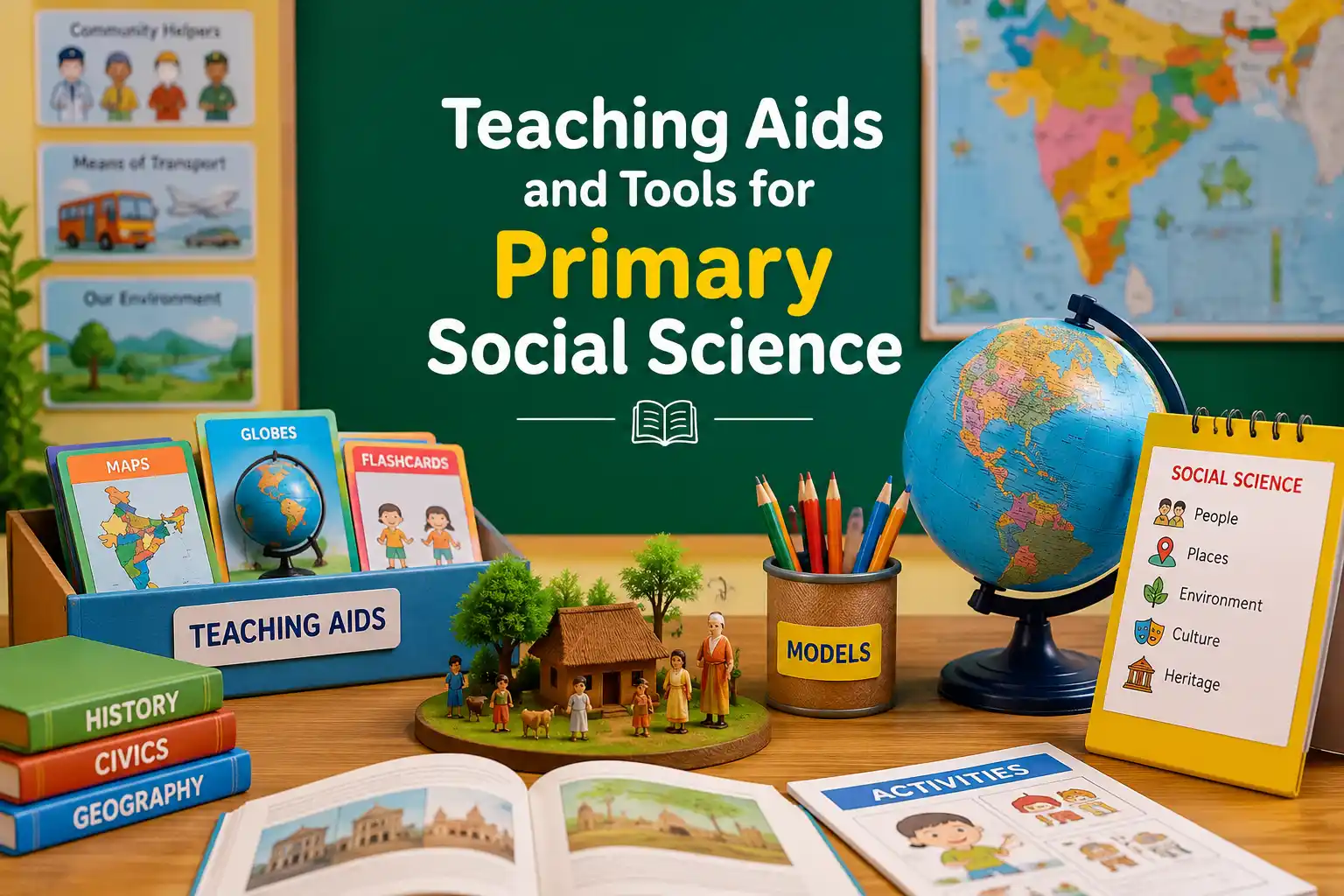
As a primary teacher, I have noticed something very important during my years of classroom experience. Children do not learn best simply by reading textbooks. Teaching aids and tools for primary social science help young learners understand concepts more easily because they can see, touch, explore, and actively participate in the learning process.
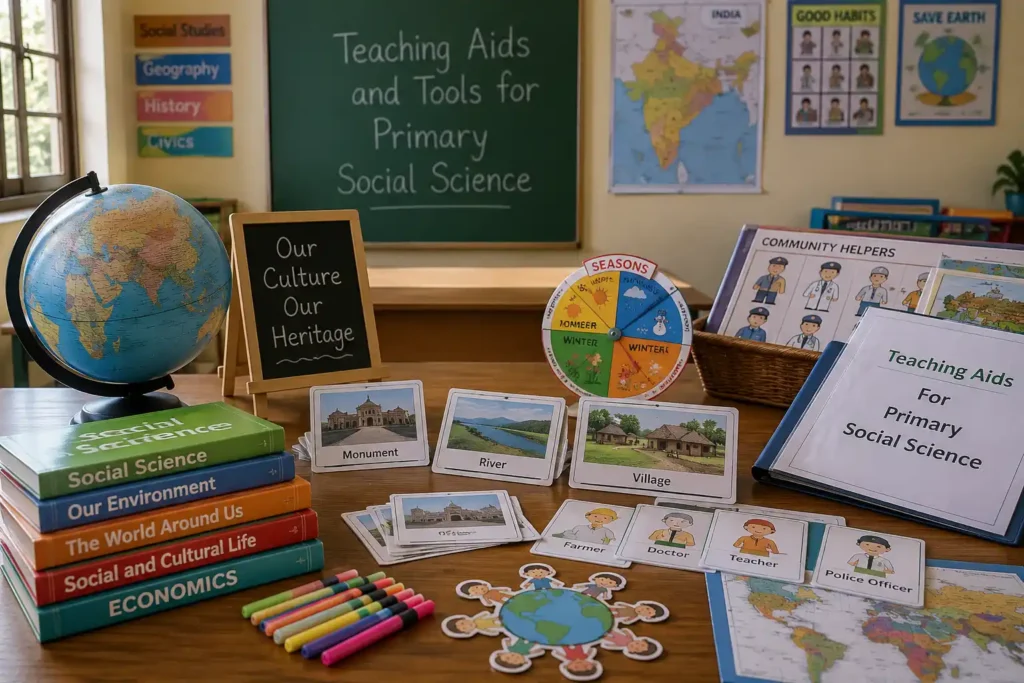
Primary social science includes topics such as family, community helpers, transport, environment, maps, festivals, history, and our country. Some of these ideas may feel abstract for children if they are taught only through lectures.
This is where teaching aids and classroom tools become powerful.
Educational organisations increasingly emphasise interactive materials, visual resources, activities, and digital tools to create engaging learning experiences for children. Resources such as visual aids, games, worksheets, and interactive activities are often used to improve participation and understanding.
In this detailed guide, I will share the top 10 teaching aids and tools for primary social science that teachers and parents can use for children from UKG to Class 5.
How Teaching Aids and Tools for Primary Social Science Learning
Before discussing the tools or methods, let us understand why they matter.
Teaching aids help:
✓ Make lessons interesting
✓ Improve memory and understanding
✓ Increase classroom participation
✓ Encourage creativity
✓ Support different learning styles
✓ Reduce fear of difficult topics
✓ Develop observation skills
Social science becomes more meaningful when children can connect concepts with real life.
For example:
Instead of explaining a map through words, showing a globe or wall map immediately creates understanding.
Instead of only reading about community helpers, role-play activities help children remember concepts better.
1. Educational Charts and Posters
Charts are among the oldest and most effective teaching aids.
Children naturally pay attention to colourful visual materials.
Examples:
- Family charts
- National symbols charts
- Transport charts
- Seasons charts
- Community helper charts
- Maps of India
- Good habits charts
Benefits
- Quick understanding
- Attractive visuals
- Better memory retention
- Suitable for all classes
Classroom Tip
Place charts on classroom walls and rotate them every week.
2. Maps and Globes
Maps and globes are essential tools for social science.
Children often struggle to understand the following:
- Countries
- States
- Directions
- Continents
- Oceans
Maps make these concepts easier.
Research and classroom-based approaches frequently recommend visual and hands-on geography resources because they help students understand locations and relationships more effectively.
Activities
Direction Game
Ask:
“Which direction is east?”
“Find Jharkhand.”
“Show India.”
Benefits
✓ Improves geographical understanding
✓ Builds map-reading skills
✓ Makes learning practical
3. Flashcards
Flashcards are small cards with images and words.
Young learners enjoy them because they look like game cards.
Examples
Front Side:
Picture of a farmer
Back Side:
Farmer
Use for:
- Freedom fighters
- Family members
- Festivals
- National symbols
- Transport
Benefits
✓ Improves recall
✓ Supports quick revision
✓ Creates fun learning
4. Picture Books and Storybooks
Children love stories.
Many social science concepts can be taught through stories.
Examples:
History
Stories of great leaders
Environment
Stories about saving trees
Civics
Stories on kindness and helping others
Benefits
✓ Develops reading habits
✓ Makes concepts relatable
✓ Improves imagination
5. Worksheets and Activity Sheets
Worksheets are among my favourite classroom tools because children learn through practice.
Interactive worksheets commonly combine visual learning, activities, and exercises to improve participation and reinforcement of concepts.
Worksheet ideas
- Matching
- Fill in the blanks
- Coloring
- MCQs
- Word search
- Drawing activities
- Labeling exercises
Example
Topic: My Family
Activities:
✓ Draw family members
✓ Match names
✓ Fill blanks
✓ Family tree
Benefits
✓ Reinforces concepts
✓ Supports home learning
✓ Improves writing skills
6. Role-play Activities
Children love pretending.
Role-play converts learning into action.
Examples
Community Helpers Day
Students become:
- Doctor
- Teacher
- Farmer
- Police officer
- Postman
Freedom Fighter Activity
Students speak in short lines as historical personalities.
Benefits
✓ Builds confidence
✓ Improves communication
✓ Encourages participation
7. Smart Boards and Digital Presentations
Modern classrooms increasingly use digital teaching methods.
Smart boards and presentation tools allow teachers to show:
- Videos
- Maps
- Images
- Animations
- Interactive quizzes
Educational platforms increasingly provide digital and interactive resources to improve engagement and differentiated learning experiences.
Benefits
✓ Makes learning interesting
✓ Supports visual learners
✓ Saves classroom time
8. Models and Mini Projects
Children enjoy creating things with their hands.
Examples:
Geography
- Volcano model
- Earth model
Civics
- Village model
- Traffic signal model
History
- Historical monument model
Benefits
✓ Hands-on learning
✓ Better understanding
✓ Improves creativity
9. Educational Games and Puzzles
Games create excitement inside classrooms.
Examples:
Puzzle activities
- State-capital puzzle
- Map puzzle
- Matching cards
Quiz games
- Rapid-fire questions
- Guess the picture
- Spin-the-wheel game
Benefits
✓ Reduces boredom
✓ Encourages teamwork
✓ Improves memory
10. Real-Life Objects and Field Visits
Real experiences create lasting learning.
Examples
- Visit a post office
- Visit a park
- Visit a museum
- Visit a local market
- Nature walk
Field-based and experiential learning approaches are commonly recommended because they help students connect classroom concepts with real-world experiences.
Benefits
✓ Practical learning
✓ Observation skills
✓ Long-term memory
Comparison Table: Teaching Aids for Primary Social Science
| Teaching Aid | Best For | Student Interest | Cost |
| Charts | Visual learning | High | Low |
| Maps and Globes | Geography | High | Medium |
| Flashcards | Revision | High | Low |
| Storybooks | Concepts | High | Medium |
| Worksheets | Practice | Very High | Low |
| Roleplay | Communication | Very High | Low |
| Smart Board | Interactive learning | Very High | High |
| Models | Hands-on learning | Very High | Medium |
| Educational Games | Revision | High | Low |
| Field Visits | Practical knowledge | Very High | Medium |
Tips for Teachers While Using Teaching Aids
Follow these simple tips:
1. Keep it colorful
Children enjoy bright colors.
2. Use age-appropriate materials
LKG children and Class 5 children need different learning tools.
3. Avoid too many materials together
Too many visuals may distract students.
4. Encourage student participation
Ask questions.
Allow children to touch and explore materials.
5. Connect lessons to daily life
Children remember real experiences better.
Common Mistakes Teachers Should Avoid
Many teachers unintentionally make mistakes, such as:
❌ Using too much text on charts
❌ Explaining without interaction
❌ Showing visuals without discussion
❌ Using difficult language
❌ Ignoring practical activities
Frequently Asked Questions (FAQs)
Which teaching aid is best for primary social science?
Worksheets, maps, flashcards, and role-play activities are among the most effective tools.
Are teaching aids necessary for small children?
Yes. Young children understand concepts better through visual and activity-based learning.
Can parents use teaching aids at home?
Yes. Parents can use flashcards, worksheets, maps, and storytelling activities.
Which teaching aid is best for geography?
Maps and globes are highly effective.
How often should teachers use teaching aids?
Teachers should try to include at least one teaching aid in every lesson.
Final Thoughts
Teaching social science should never become memorising facts from textbooks.
Children learn better when lessons become enjoyable experiences.
The right combination of charts, worksheets, maps, activities, games, and digital tools can transform an ordinary classroom into an exciting learning environment.
As a teacher, I have observed that children remember lessons longer when they actively participate rather than just listen.
Start with simple tools and gradually add more activities. Small changes often create meaningful learning experiences.
Written by: Shilki Kumari
Primary Social Science & EVS Teacher
KidsTeacherShilki.in