
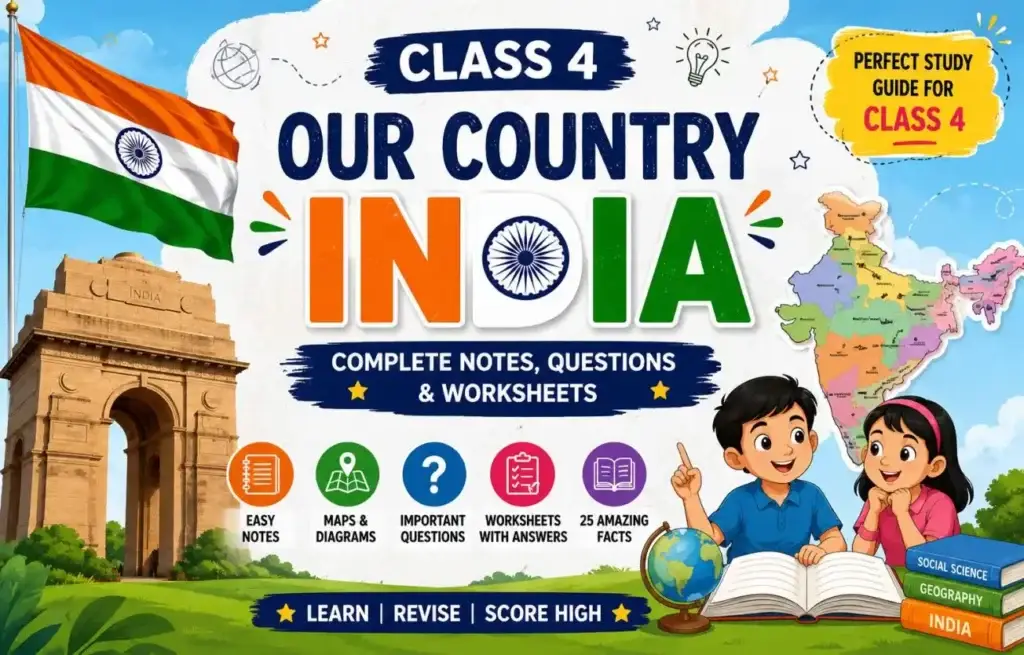
Class 4 Our Country India Chapter Complete Notes & Worksheets

Class 4 Our Country India Chapter Complete Notes & Worksheets

Welcome to KidsTeacherShilki.in ❤️

Class 4 Our Country India is one of the most important chapters in Social Science. This chapter helps students learn about India’s location, size, neighbouring countries, physical features, states, union territories, and national symbols. It also teaches children to respect and love their country.

India is a land of rich culture, traditions, languages, festivals, and natural beauty. By studying Class 4 Our Country India, students gain a better understanding of their nation and develop a sense of pride in being Indian.

In this complete guide, you will find:

  • Easy-to-understand notes
  • Important facts and points
  • Physical features of India
  • Neighbouring countries
  • States and Union Territories
  • Important questions and answers
  • Worksheet ideas
  • Exam preparation tips

Let’s begin our exciting journey to learn about our incredible country!

Introduction to Class 4 Our Country India

India is our homeland. It is one of the largest and most populated countries in the world. People of different religions, cultures, languages, and traditions live together peacefully in India.


Our country is famous for its historical monuments, natural beauty, scientific achievements, and cultural heritage. India is often called the “Land of Diversity” because people from different backgrounds live here while maintaining unity.

Learning Class 4 Our Country India helps children understand the importance of national unity and cultural diversity.

Location and Size of India

India is located in South Asia and is the seventh-largest country in the world by area. It occupies an important position on the world map and has a rich geographical diversity.

Important Dimensions of India

  • North to South Distance: About 3,214 km
  • East to West Distance: About 2,933 km
  • Total Area: About 3.28 million square kilometres

India’s vast size allows it to have different climates, landscapes, and cultures across various regions.

Capital of India

New Delhi is the capital city of India. It is the center of the country’s government and administration.

Geographical Position of India

India lies in the Northern Hemisphere and enjoys a strategic location in Asia. It is bordered by mountains in the north and oceans in the south.

Why India is Called a Peninsula

A peninsula is a landmass that is surrounded by water on three sides. India is called a peninsula because it is surrounded by water bodies on three sides.

  • Arabian Sea in the West
  • Bay of Bengal in the East
  • Indian Ocean in the South

Importance of the Seas Around India

The seas surrounding India are important because they help in:

  • Trade and transportation
  • Fishing activities
  • Tourism development
  • Climate control

These water bodies play a significant role in India’s economy and environment.

Neighbouring Countries of India

India shares borders with several countries. These neighbouring countries help India maintain trade, cultural exchange, and diplomatic relations.

Land Neighbours of India

  • Pakistan – West
  • China – North
  • Nepal – North
  • Bhutan – North
  • Bangladesh – East
  • Myanmar – East
  • Afghanistan – North-West

Island Neighbours of India

• Sri Lanka

• Maldives

Importance of Neighbouring Countrie

Neighbouring countries contribute to:


• Trade and commerce

• Tourism

• Cultural exchange

• Regional cooperation

Easy Trick to Remember India's Neighbours

Pakistan – China – Nepal – Bhutan – Bangladesh – Myanmar – Afghanistan


This sequence helps students remember the neighbouring countries easily.

Physical Features of India

Pakistan – China – Nepal – Bhutan – Bangladesh – Myanmar – Afghanistan


This sequence helps students remember the neighbouring countries easily.

1. The Himalayas

The Himalayas are located in northern India and are the highest mountain range in the world.

Features of the Himalayas

  • Snow-covered mountains
  • Source of many rivers
  • Natural barrier against cold winds
  • Rich biodiversity

Importance of the Himalayas

The Himalayas influence India’s climate and provide water through major rivers.

2. The Northern Plains

The Northern Plains are one of the most fertile regions of India.

Features of Northern Plains

  • Flat and fertile land
  • Formed by rivers like Ganga and Yamuna
  • Densely populated
  • Suitable for agriculture

Crops Grown in the Northern Plains

  • Rice
  • Wheat
  • Sugarcane
  • Vegetables

3. The Peninsular Plateau

The Peninsular Plateau is located in southern India and is rich in mineral resources.

Features of the Plateau

  • Triangular shape
  • Rocky terrain
  • Rich mineral deposits
  • Ancient landform

Minerals Found in the Plateau Region

  • Iron Ore
  • Coal
  • Manganese
  • Bauxite

4. The Indian Desert (Thar Desert)

The Thar Desert is located mainly in Rajasthan.

Features of the Desert

People living in desert areas use special methods to conserve water and adapt to the climate.

5. The Coastal Plains

The Coastal Plains lie along the Arabian Sea and Bay of Bengal.

Features of Coastal Plains

  • Fertile land
  • Fishing activities
  • Important ports
  • Beautiful beaches

Importance of Coastal Regions

Coastal regions support tourism, fishing, and international trade.

6. The Islands

India has two major groups of islands.

Andaman and Nicobar Islands

Located in the Bay of Bengal and known for their scenic beauty.

Lakshadweep Islands

Located in the Arabian Sea and famous for coral reefs.

Importance of Islands

The islands contribute to tourism, biodiversity, and maritime security.

States and Union Territories of India

Present Administrative Division

  • 28 States
  • 8 Union Territories

What Are States?

States have their own governments and administrative systems.

Largest and Smallest States

  • Largest State: Rajasthan
  • Smallest State: Goa

National Symbols of India

National Flag

The Indian National Flag is called the Tricolour.

National Anthem

Jana Gana Mana

National Song

Vande Mataram

National Animal

Tiger

National Bird

Peacock

National Flower

Lotus

National Fruit

Mango

National Tree

Banyan Tree

Class 4 Our Country India Important Questions and Answers

Q1. Why is India called a peninsula?

Answer: India is called a peninsula because it is surrounded by water on three sides.

Q2. What is the capital of India?

Answer: New Delhi.

Q3. Name the neighbouring countries of India.

Answer: Pakistan, China, Nepal, Bhutan, Bangladesh, Myanmar, and Afghanistan.

Download Button

Conclusion

Class 4 Our Country India is an important chapter that teaches students about the geography, physical features, neighbouring countries, states, union territories, and national symbols of India. Understanding this chapter helps students develop patriotism and a deeper appreciation for their nation. Regular revision and map practice will help students score excellent marks in examinations and gain valuable knowledge about their country.

Previous Post
Next Post

Leave a Reply

Your email address will not be published. Required fields are marked *

Free worksheets from KidsTeacherShilki.in

Download the free worksheets available on this website and make your task easy.

Category

Latest posts

  • All Posts
  • Adventures
  • Chapter Notes
  • Class 5 Science Question and Answer
  • Creations
  • Geography
  • Kids Score
  • Learning
  • Our Country India
  • Social Science Books
  • Social Science Exam
  • Social Science Portfolio
  • Social Science Projects
  • Social Science Syllabus
  • Social Science Worksheets
  • SST Project
  • Storybook
  • Teaching Aids
  • Teaching Method
  • Tool

Tags

Contact Info

If you have any questions or concerns about this Blog posts, you may contact me through email.

Edit Template

About Kids Teacher Shilki Kumari

Kids Teacher Shilki Kumari makes Social Science and EVS fun and easy for UKG to Class 5 students.

Legal & Policy

© 2026 Created with Royal Elementor Addons by Amar Deep Singh