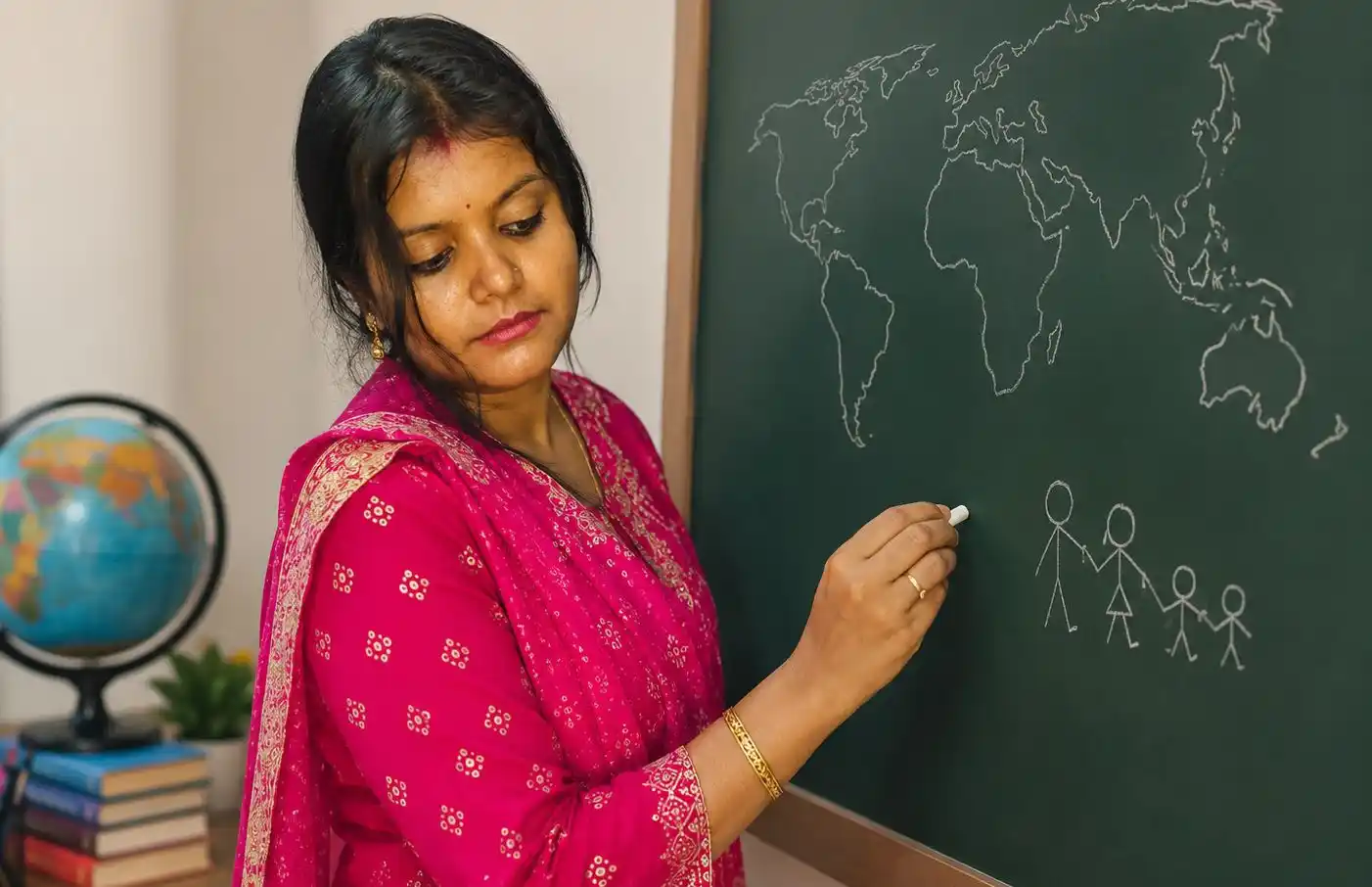
Best Lesson Plans for Social Science are the foundation of engaging, organized, and effective classroom teaching. Whether you teach UKG, primary classes, or support your child at home, a well-designed lesson plan helps children understand concepts through stories, activities, discussions, and real-life experiences instead of rote memorization.
Social Science introduces children to the world around them. From learning about family and neighbourhood in UKG and Class 1 to understanding India’s geography, culture, environment, and citizenship in higher primary classes, every lesson shapes a child’s thinking and develops responsible future citizens.
I am Kids Teacher Shilki, and after teaching young learners for several years, I have learned that students enjoy Social Science the most when lessons are interactive, activity-based, and connected with everyday life. That is why I created this detailed guide containing some of the Best Lesson Plans for Social Science that you can use directly in your classroom or adapt according to your students’ learning needs.
Each lesson plan shared in this guide follows the principles of the National Education Policy (NEP 2020) by promoting experiential learning, collaborative activities, critical thinking, and joyful classroom experiences. Whether you are a new teacher preparing your first lesson or an experienced educator looking for fresh teaching ideas, this comprehensive guide will help you save time while improving classroom engagement.
Unlike traditional lesson plans that focus only on textbook explanations, these ready-to-use lesson plans include clear learning objectives, classroom activities, assessment methods, teaching aids, worksheets, and homework suggestions. Every lesson is designed to keep children actively involved throughout the class.tters
Many teachers spend hours preparing classroom activities, yet without proper planning, even the best ideas can become confusing for students. A structured lesson plan ensures that every minute of the class is meaningful and supports learning objectives.
A thoughtfully designed lesson plan helps teachers:
- Teach with confidence.
- Manage classroom time effectively.
- Keep students engaged.
- Meet curriculum goals.
- Assess student understanding accurately.
- Build children’s curiosity through practical learning.
When students know what they are learning and why it matters, they become active participants rather than passive listeners. This is one of the biggest reasons why experienced educators always emphasize preparing lesson plans before entering the classroom.
What Makes the Best Lesson Plans for Social Science?
The Best Lesson Plans for Social Science are not simply lists of activities. They combine clear objectives, meaningful discussions, hands-on experiences, and continuous assessment to create an enjoyable learning environment.
An excellent lesson plan should:
- Match the learning level of students.
- Include real-life examples.
- Encourage observation and discussion.
- Promote teamwork and communication.
- Include creative classroom activities.
- Use maps, charts, flashcards, pictures, and models.
- End with reflection and assessment.
Children remember experiences far better than lectures. Instead of merely telling students about different occupations, for example, invite them to role-play as doctors, teachers, farmers, or police officers. Such activities make learning memorable and enjoyable.
Components of an Effective Social Science Lesson Plan
Every successful lesson plan follows a logical sequence that supports learning from beginning to end.
1. Topic
Choose a clear and specific topic from the syllabus.
Examples include:
- My Family
- My School
- Festivals of India
- Our Environment
- Physical Features of India
- Rights and Responsibilities
Keeping the topic focused prevents students from feeling overwhelmed.
2. Grade Level
Mention the class or age group clearly because teaching strategies vary significantly between UKG and Class 5.
For example:
- UKG: Storytelling and picture recognition
- Class 2: Drawing and group discussion
- Class 5: Projects, debates, and poster presentations
3. Learning Objectives
Learning objectives describe what students should know or be able to do after completing the lesson.
Good objectives are specific and measurable.
For example:
- Identify members of a family.
- Explain the importance of festivals.
- Label the physical divisions of India.
- Describe ways to protect the environment.
- Differentiate between rights and responsibilities.
Clear objectives also make assessment easier for teachers.
4. Teaching-Learning Materials (TLM)
Visual and hands-on teaching aids make lessons more interesting.
Useful materials include:
- Flashcards
- Maps
- Globe
- Charts
- Picture cards
- Worksheets
- Puppets
- Storybooks
- Videos
- Activity sheets
- Drawing materials
Teaching-learning materials encourage observation, curiosity, and participation.
5. Introduction or Warm-Up
The first five to ten minutes determine how engaged students will be for the rest of the lesson.
Instead of directly opening the textbook, begin with:
- A simple question
- A picture
- A short story
- A classroom game
- A song
- A real-life object
- A brainstorming activity
These warm-up techniques activate prior knowledge and create excitement.
6. Core Teaching
This is the main instructional part of the lesson.
Keep explanations short and interactive by asking questions throughout the lesson.
For example:
“What do you notice?”
“Have you ever visited this place?”
“Can anyone share an experience?”
Children learn more when they actively participate in discussions.
7. Activity-Based Learning
NEP 2020 strongly recommends experiential learning.
Examples include:
- Group discussions
- Map colouring
- Matching worksheets
- Role play
- Poster making
- Model making
- Story completion
- Picture sorting
- Quiz games
- Think-Pair-Share
Activities improve understanding while making lessons enjoyable.
8. Assessment
Assessment should be continuous rather than limited to written tests.
Teachers can assess students through:
- Oral questioning
- Observation
- Printable Social Science Worksheets
- Group participation
- Drawing activities
- Classroom discussions
- Exit tickets
- Project work
Assessment helps identify learning gaps early.
9. Homework
Homework should reinforce classroom learning rather than create unnecessary pressure.
Examples include:
- Draw your family.
- Observe your neighbourhood.
- Collect festival pictures.
- Interview grandparents.
- Label an India map.
- Write five sentences about protecting nature.
Meaningful homework strengthens understanding beyond the classroom.
Benefits of Activity-Based Social Science Teaching
Modern classrooms are shifting from teacher-centred instruction to learner-centred experiences. Children learn more effectively when they actively explore concepts rather than simply listening to explanations.
Some key benefits include:
- Increased classroom participation.
- Better retention of concepts.
- Improved communication skills.
- Development of critical thinking.
- Greater creativity and imagination.
- Stronger teamwork and collaboration.
- Higher confidence during presentations.
- Better connection between classroom learning and real life.
For example, instead of only reading about community helpers, students can interview a local shopkeeper, doctor, or police officer. Such experiences help children understand how different people contribute to society.
How NEP 2020 Transforms Social Science Teaching
The National Education Policy (NEP 2020) encourages teachers to move beyond memorization and adopt practical, competency-based learning.
Some important principles include:
- Experiential learning
- Inquiry-based teaching
- Project-based activities
- Collaborative learning
- Local context integration
- Multidisciplinary connections
- Skill development
- Continuous assessment
By following these principles, teachers can make Social Science more meaningful and enjoyable for young learners.
The ready-to-use lesson plans in the following sections are designed with these recommendations in mind, helping you create classrooms where children observe, question, discuss, and discover the world around them with confidence.
Best Lesson Plans for Social Science for UKG, Class 1, and Class 2
The Best Lesson Plans for Social Science focus on making learning meaningful through storytelling, observation, games, and hands-on activities. Young children learn best when they actively participate rather than simply listening to explanations. The following lesson plans are classroom-tested, child-friendly, and aligned with the experiential learning approach recommended by NEP 2020.
Lesson Plan 1: My Family (UKG)
Topic
My Family
Grade: UKG
Duration: 25–30 Minutes
Learning Objectives
By the end of the lesson, students will be able to:
- Identify different family members.
- Understand the importance of family.
- Recognize the role of each family member.
- Express love, care, and respect for their family.
- Improve speaking and observation skills.
Teaching-Learning Materials (TLM)
- Family picture cards
- Flashcards
- Puppets
- Drawing sheets
- Crayons or colour pencils
- Chart paper
- Family rhyme audio (optional)
Warm-Up Activity (5 Minutes)
Welcome children with a cheerful greeting.
Begin by asking simple questions:
- Who lives with you at home?
- Who wakes you up in the morning?
- Who helps you with homework?
- Who loves you the most?
Allow several students to answer.
Now sing a simple family rhyme together while showing family flashcards.
This creates excitement before beginning the lesson.
Introduction
Show a colourful family picture.
Ask students to carefully observe it.
Encourage discussion by asking:
- How many people can you see?
- Can you find the grandfather?
- What is the little girl doing?
- Is everyone happy?
Explain that every family is special and every member has an important role.
Core Teaching (12 Minutes)
Introduce each family member one by one.
Discuss:
Father
- Goes to work
- Takes care of the family
- Loves and protects everyone
Mother
- Cooks food
- Helps children
- Takes care of the home
Grandparents
- Tell stories
- Share experiences
- Teach good manners
Brother and Sister
- Play together
- Share toys
- Help each other
Explain that families may be big or small, but every family is filled with love and care.
Classroom Activity
Ask children to stand in a circle.
Play the game:
“Who Am I?”
Give clues such as:
“I cook delicious food.”
“I tell bedtime stories.”
“I go to school with you.”
Students guess the correct family member.
This activity improves listening and thinking skills.
Worksheet Activity
Students draw their own family.
They label:
- Father
- Mother
- Brother
- Sister
- Grandfather
- Grandmother
- Me
Teachers can help children who are still learning to write.
Assessment
Observe whether students can:
- Name family members correctly.
- Participate in discussion.
- Complete the drawing activity.
- Answer simple oral questions.
Homework
Talk to every family member today and say:
“Thank you for taking care of me.”
Draw one happy moment with your family.
Learning Outcome
Students develop emotional bonding, improve vocabulary, and understand the value of family relationships.
Lesson Plan 2: My School and Neighbourhood (Class 1)
Topic
My School and Neighbourhood
Grade: Class 1
Duration: 35 Minutes
Learning Objectives
Students will:
- Identify important places around them.
- Understand why schools and neighbourhoods are important.
- Learn basic map awareness.
- Improve observation skills.
- Build confidence through discussion.
Materials Required
- Flashcards
- School photographs
- Picture cards
- Drawing notebook
- Worksheets
- Colour pencils
Warm-Up (5 Minutes)
Ask students:
- What is your favourite place in school?
- Which teacher do you like most?
- What places do you see near your home?
Allow students to share personal experiences.
Introduction
Display flashcards showing:
- School
- Hospital
- Park
- Police Station
- Temple
- Market
- Bus Stop
- Library
Ask students if they have visited these places.
Core Teaching
Explain each place using simple language.
School
- We come here to learn.
- Teachers help us gain knowledge.
- We make friends.
Hospital
- Doctors treat sick people.
- Nurses care for patients.
Market
- We buy fruits, vegetables, clothes, and other daily needs.
Park
- Children play games.
- Families enjoy spending time together.
Police Station
- Police officers help keep people safe.
Library
- Books increase our knowledge.
- Reading develops imagination.
Activity 1: Picture Matching
Give students worksheets.
They match each place with its correct function.
For example:
Hospital → Doctor
Library → Books
School → Study
Market → Shopping
Activity 2: Draw My Way to School
Students draw:
- Their home
- Roads
- Trees
- School
- Shops
- Traffic signals
This introduces basic map skills.
Group Discussion
Ask:
Why should we keep our neighbourhood clean?
Expected answers:
- Healthy environment
- Beautiful surroundings
- Less disease
- Safe places to play
Assessment
Check whether students can:
- Identify different places.
- Explain their importance.
- Complete matching activities.
- Participate confidently.
Homework
Draw your favourite place in your neighbourhood.
Write two simple sentences about it.
Learning Outcome
Students understand their surroundings and develop observation, communication, and civic awareness.
Lesson Plan 3: Festivals of India (Class 2)
Topic
Festivals of India
Grade: Class 2
Duration: 40 Minutes
Learning Objectives
Students will:
- Identify major Indian festivals.
- Understand why festivals are celebrated.
- Appreciate India’s cultural diversity.
- Learn values of sharing and unity.
Teaching Materials
- Festival flashcards
- Pictures
- Videos (optional)
- Drawing sheets
- Chart paper
- Colour pencils
Warm-Up
Ask students:
- Which festival do you enjoy most?
- What special food do you eat?
- What decorations do you make?
Children enjoy sharing their experiences.
Introduction
Show colourful festival pictures.
Include:
- Diwali
- Holi
- Eid
- Christmas
- Guru Nanak Jayanti
- Pongal
- Baisakhi
- Onam
Explain that India celebrates many festivals because it is a country of different cultures and traditions.
Core Teaching
Diwali
- Festival of Lights
- Diyas
- Rangoli
- Sweets
- Family celebrations
Holi
- Festival of Colours
- Friendship
- Happiness
- Water colours
Eid
- Sharing
- Charity
- Family prayers
- Delicious food
Christmas
- Birthday of Jesus Christ
- Christmas Tree
- Gifts
- Santa Claus
Explain that every festival teaches love, kindness, sharing, and respect.
Classroom Activity
Divide students into groups.
Assign one festival to each group.
Each group prepares:
- Festival name
- Special food
- Dress
- Decorations
- One interesting fact
Groups present their work.
Art Activity
Students prepare a mini poster titled:
My Favourite Festival
Include:
- Drawing
- Festival name
- Three interesting facts
Worksheet
Fill in the blanks.
Match festivals with symbols.
Colour festival pictures.
Circle the correct answers.
Value-Based Discussion
Ask:
Why should we respect festivals celebrated by others?
Guide students toward answers such as:
- Respect all religions.
- Celebrate together.
- Build friendship.
- Promote peace.
Assessment
Observe:
- Participation
- Speaking confidence
- Creativity
- Correct identification of festivals
- Worksheet performance
Homework
Draw your favourite festival.
Write five sentences explaining:
- Why you celebrate it.
- What food you enjoy.
- What you like most.
Learning Outcome
Students appreciate India’s rich cultural heritage while learning values such as respect, cooperation, unity, and inclusion.
Teaching Tips for UKG to Class 2 Social Science
Young learners require frequent interaction and movement. Long lectures often reduce attention, so keep explanations brief and include engaging activities every few minutes.
Some practical tips include:
- Use colourful teaching aids.
- Encourage children to ask questions.
- Include songs, rhymes, and storytelling.
- Appreciate every child’s participation.
- Connect lessons with daily life.
- Allow students to work in pairs or small groups.
- Repeat key ideas using simple language.
- Use praise and positive reinforcement to build confidence.
Remember that children at this stage learn best through experience. A lesson filled with discussion, creativity, and hands-on activities is far more effective than one based only on reading from the textbook.
The Best Lesson Plans for Social Science always encourage children to observe, explore, communicate, and enjoy the learning process while developing essential life skills alongside academic knowledge.
Best Lesson Plans for Social Science for Class 3, Class 4, and Class 5
As students move into the upper primary grades, Social Science becomes more than just learning about family and surroundings. Children begin exploring topics such as the environment, geography, culture, citizenship, and the responsibilities of being a good member of society. The Best Lesson Plans for Social Science encourage inquiry, observation, collaboration, and problem-solving, helping students connect textbook concepts with the real world.
The lesson plans below are activity-based, competency-focused, and aligned with the vision of NEP 2020, making learning enjoyable while building critical thinking and communication skills.
Lesson Plan 4: Our Environment (Class 3)
Topic
Our Environment
Grade: Class 3
Duration: 40–45 Minutes
Learning Objectives
By the end of the lesson, students will be able to:
- Define the term environment.
- Differentiate between living (biotic) and non-living (abiotic) components.
- Identify common types of pollution.
- Explain simple ways to protect the environment.
- Develop awareness about environmental conservation.
Teaching-Learning Materials (TLM)
- Pictures of clean and polluted surroundings
- Flashcards
- Chart paper
- Green and blue coloured sheets
- Worksheets
- Dustbin models (green and blue)
- Plant saplings (optional)
- Short environmental awareness video (optional)
Warm-Up Activity (5 Minutes)
Display two large pictures:
- A clean park with trees and flowers.
- A polluted area with garbage and smoke.
Ask students:
- Which place would you like to visit?
- Which picture looks healthier?
- What differences do you notice?
Allow students to share observations before introducing the topic.
Introduction
Explain that everything around us forms our environment.
Our environment includes:
- Air
- Water
- Trees
- Animals
- Birds
- Mountains
- Rivers
- Human beings
Tell students that keeping our environment clean is everyone’s responsibility.
Core Teaching (20 Minutes)
What is Environment?
The environment is everything that surrounds us and supports life.
It includes both natural and human-made surroundings.
Biotic Components
These are living things.
Examples:
- Humans
- Animals
- Birds
- Trees
- Plants
- Insects
Abiotic Components
These are non-living things.
Examples:
- Air
- Water
- Soil
- Rocks
- Sunlight
Types of Pollution
Air Pollution
Caused by:
- Vehicle smoke
- Factory emissions
- Burning waste
Effects:
- Breathing problems
- Dirty air
- Global warming
Water Pollution
Caused by:
- Plastic waste
- Dirty sewage
- Industrial waste
Effects:
- Unsafe drinking water
- Harm to aquatic life
Land Pollution
Caused by:
- Plastic litter
- Garbage dumping
- Excessive waste
Effects:
- Dirty surroundings
- Spread of diseases
Classroom Activity 1: Green or Red?
Show different picture cards.
Students decide whether each action is:
- Good for the environment (Green)
- Harmful to the environment (Red)
Examples:
- Planting trees ✔
- Throwing garbage on roads ✘
- Saving water ✔
- Burning plastic ✘
Classroom Activity 2: Save the Earth Poster
Students create posters using slogans such as:
- Save Trees
- Save Water
- Go Green
- Keep Earth Clean
- Say No to Plastic
Display the posters on the classroom notice board.
Worksheet Activity
Students answer:
- Write five ways to protect nature.
- Circle environmentally friendly actions.
- Match pollution types with their causes.
- Colour the recycling symbol.
Assessment
Evaluate students through:
- Oral questioning
- Group participation
- Poster presentation
- Worksheet completion
- Classroom discussion
Homework
Plant one small plant at home.
Observe it for one week.
Write three sentences describing how you cared for it.
Learning Outcome
Students develop environmental awareness and understand how simple daily actions can help protect nature.
Lesson Plan 5: Our Country India – Physical Features (Class 4)
Topic
Physical Features of India
Grade: Class 4
Duration: 45 Minutes
Learning Objectives
Students will:
- Identify the six major physical divisions of India.
- Locate them on a map.
- Understand the importance of each region.
- Develop basic map-reading skills.
Teaching Materials
- Physical map of India
- Globe
- Atlas
- Mountain, desert, and coastal photographs
- Flashcards
- Colour pencils
- Blank outline maps
Warm-Up
Show the physical map of India.
Ask:
- Have you ever visited mountains?
- Have you seen a desert?
- Where do beaches exist?
- Which places are very cold?
Allow students to connect personal experiences with geography.
Introduction
Explain that India is a diverse country with many different landforms.
Every region has unique weather, plants, animals, and ways of living.
Core Teaching
1. The Himalayas
- Highest mountain range
- Snow-covered peaks
- Source of many rivers
- Popular tourist destination
Importance:
- Protects India from cold winds.
- Provides fresh water through rivers.
2. Northern Plains
- Fertile land
- Rich agriculture
- Densely populated
Major crops:
- Wheat
- Rice
- Sugarcane
3. Peninsular Plateau
- Rich in minerals
- Rocky landforms
- Ancient mountains
Important minerals:
- Coal
- Iron ore
- Manganese
4. Thar Desert
- Located in Rajasthan
- Sandy region
- Very little rainfall
Animals:
- Camel
- Desert fox
5. Coastal Plains
Found along:
- Arabian Sea
- Bay of Bengal
Importance:
- Fishing
- Ports
- Tourism
- Coconut farming
6. Islands
India has island groups:
- Andaman and Nicobar Islands
- Lakshadweep Islands
Importance:
- Tourism
- Marine biodiversity
- Strategic location
Classroom Activity
Give every student an outline map.
Ask them to:
- Colour mountains brown.
- Plains green.
- Plateau yellow.
- Desert orange.
- Coastal plains blue.
- Islands purple.
Label every region neatly.
Group Activity
Divide students into six groups.
Each group prepares a short presentation on one physical division.
Include:
- Climate
- Animals
- Crops
- Tourist attractions
Groups present to the class.
Worksheet
Students complete:
- Label the map.
- Match landforms with characteristics.
- Fill in the blanks.
- Multiple-choice questions.
Assessment
Observe:
- Map skills
- Group participation
- Oral responses
- Accuracy of worksheet
Homework
Write five sentences describing your favourite physical feature of India.
Draw one related picture.
Learning Outcome
Students gain confidence in identifying India’s physical features while improving observation, map-reading, and presentation skills.
Lesson Plan 6: Rights and Responsibilities (Class 5)
Topic
Rights and Responsibilities
Grade: Class 5
Duration: 45 Minutes
Learning Objectives
Students will:
- Understand the meaning of rights.
- Learn basic Fundamental Rights.
- Recognize their responsibilities as citizens.
- Develop civic awareness and respect for others.
Teaching Materials
- Chart on Fundamental Rights
- Constitution-themed flashcards
- Poster-making materials
- Worksheets
- Sticky notes
Warm-Up
Ask students:
- What freedoms do you enjoy?
- Should every child go to school?
- Why should we follow school rules?
Encourage open discussion.
Introduction
Explain that every citizen has rights that help them live with dignity and equality.
Along with rights come responsibilities.
Both are equally important for a peaceful society.
Core Teaching
Fundamental Rights (Simplified)
Introduce child-friendly examples of rights, such as:
- Right to Equality
- Right to Freedom
- Right to Education
- Right against Exploitation
- Freedom of Religion
- Cultural and Educational Rights
Discuss how these rights help people live safely and fairly.
Responsibilities
Explain that good citizens:
- Respect elders.
- Follow rules.
- Keep surroundings clean.
- Protect public property.
- Respect different cultures and religions.
- Help others.
- Save water and electricity.
Real-Life Discussion
Present classroom situations.
Ask students what they would do.
Examples:
- Someone throws litter in the park.
- A classmate is being bullied.
- Water is being wasted.
- A library book is damaged.
Discuss responsible actions together.
Poster Activity
Students create a poster titled:
My Rights and My Responsibilities
Include:
- Drawings
- Slogans
- Examples from daily life
Display posters in the classroom.
Role Play
Groups perform short skits showing:
- Responsible citizens
- Respecting school rules
- Helping neighbours
- Protecting public property
Role play builds confidence and practical understanding.
Worksheet
Students complete:
- Match rights with examples.
- True or False.
- Fill in the blanks.
- Write three responsibilities of a good citizen.
Assessment
Teachers evaluate:
- Participation
- Creativity
- Communication skills
- Worksheet accuracy
- Understanding during role play
Homework
Write a short paragraph titled:
“I Am a Responsible Citizen Because…”
Mention at least five responsibilities you follow at home and in school.
Learning Outcome
Students understand that responsible behaviour strengthens families, schools, communities, and the nation while developing values such as respect, honesty, empathy, and cooperation.
Classroom Management Tips for Classes 3 to 5
As children grow older, they enjoy greater responsibility and opportunities to express their ideas. Effective classroom management helps maintain engagement and encourages active participation.
Some practical strategies include:
- Begin every lesson with an interesting question or real-life example.
- Use maps, globes, charts, and digital resources wherever possible.
- Encourage pair work and group discussions.
- Rotate leadership roles during classroom activities.
- Give positive feedback to motivate learners.
- Include project work, quizzes, and presentations to make learning interactive.
- Use formative assessment regularly instead of relying only on written tests.
- Relate every lesson to students’ daily experiences so concepts become meaningful.
These approaches help transform Social Science from a theory-based subject into an engaging journey of discovery, making it easier for students to remember concepts and apply them in real life.
The Best Lesson Plans for Social Science are those that inspire curiosity, encourage participation, and help children become informed, responsible, and compassionate citizens.
General Tips for Creating the Best Lesson Plans for Social Science
Creating effective lesson plans is not difficult when you understand your students’ needs and learning styles. The Best Lesson Plans for Social Science are those that balance knowledge with activities, encourage curiosity, and provide opportunities for every child to participate.
Here are some practical tips that I have learned from my classroom experience.
1. Begin Every Lesson with a Strong Hook
The first few minutes of a lesson determine how interested students will be for the rest of the class. Instead of opening the textbook immediately, capture students’ attention with something engaging.
You can begin with:
- A thought-provoking question
- A short story
- A colourful picture
- A classroom game
- A simple puzzle
- A real-life object
- A short video clip (if available)
For example, before teaching Our Environment, show students a clean and a polluted area. Ask them which place they would prefer to live in and why. This simple activity encourages observation and discussion before introducing the lesson.
2. Use Activity-Based Learning
Children remember what they experience. Every lesson should include at least one hands-on activity.
Some effective classroom activities include:
- Role play
- Group discussion
- Poster making
- Picture sorting
- Flashcard games
- Storytelling
- Quiz competitions
- Drawing and colouring
- Map work
- Think-Pair-Share
- Observation tasks
These activities improve understanding while making lessons enjoyable.
3. Use Simple and Child-Friendly Language
Avoid using difficult words, especially in UKG and primary classes.
Instead of lengthy explanations, use short sentences and familiar examples from daily life.
For instance, while teaching community helpers, relate each profession to someone the children may already know, such as their family doctor, school teacher, or neighbourhood shopkeeper.
4. Connect Lessons with Real Life
Children understand concepts more easily when they see how they apply in everyday situations.
Examples include:
- Discussing family responsibilities during the “My Family” lesson.
- Observing traffic rules while learning about neighbourhoods.
- Planting a sapling during an environment lesson.
- Reading a simple weather chart while studying seasons.
- Identifying landforms on a map while discussing India.
Real-life connections make learning meaningful and memorable.
5. Encourage Every Child to Participate
Some students are naturally confident, while others may hesitate to speak.
Create opportunities for everyone by:
- Asking open-ended questions
- Organizing pair work
- Rotating group leaders
- Appreciating every answer
- Using games and collaborative activities
Positive encouragement builds confidence and creates an inclusive classroom.
6. Assess Learning Continuously
Assessment should not happen only at the end of a chapter.
Use continuous assessment methods such as:
- Oral questioning
- Observation
- Exit tickets
- Worksheets
- Peer discussion
- Project work
- Quiz games
- Presentation activities
These methods help identify learning gaps and provide timely support.
7. End Every Lesson with Reflection
Reserve the last few minutes of each class for reflection.
Ask students questions like:
- What new thing did you learn today?
- What activity did you enjoy the most?
- Can you explain today’s topic in one sentence?
- How will you use this knowledge in daily life?
Reflection reinforces learning and helps students retain concepts for a longer time.
Ready-to-Use Social Science Lesson Plan Template
You can use the following template to prepare lesson plans for any Social Science topic.
Topic:
Class/Grade:
Duration:
Learning Objectives:
Teaching-Learning Materials (TLM):
Previous Knowledge:
Warm-Up Activity:
Introduction:
Core Teaching:
Classroom Activity:
Worksheet/Practice:
Assessment:
Homework:
Learning Outcomes:
This simple structure keeps lessons organized and easy to follow.
Common Mistakes Teachers Should Avoid
Even experienced teachers can make planning mistakes. Being aware of them can improve classroom teaching.
Avoid these common issues:
- Explaining for too long without interaction.
- Ignoring students’ prior knowledge.
- Using only textbook reading.
- Skipping classroom activities.
- Asking only yes/no questions.
- Giving homework that does not reinforce learning.
- Rushing through assessments.
- Using teaching aids that are not suitable for the age group.
A well-balanced lesson includes explanation, interaction, practice, and reflection.
How NEP 2020 Supports Social Science Teaching
The National Education Policy (NEP 2020) emphasizes competency-based learning rather than rote memorization.
Some important recommendations include:
- Experiential learning
- Inquiry-based teaching
- Project work
- Collaborative learning
- Critical thinking
- Multidisciplinary learning
- Continuous assessment
- Integration of local context
By following these principles, teachers can make Social Science more engaging and meaningful for every learner.
Frequently Asked Questions (FAQs)
1. What is a Social Science lesson plan?
A Social Science lesson plan is a structured teaching guide that outlines learning objectives, teaching methods, classroom activities, assessments, and homework for a specific topic.
2. Why are lesson plans important for primary classes?
Lesson plans help teachers organize their teaching, manage classroom time effectively, and ensure that learning objectives are achieved through engaging activities.
3. How long should a Social Science lesson be?
For UKG, lessons usually last 25–30 minutes, while Classes 1 to 5 generally require 35–45 minutes, depending on the topic and activities.
4. What should every lesson plan include?
A good lesson plan should include:
- Topic
- Grade level
- Learning objectives
- Teaching materials
- Introduction
- Core teaching
- Classroom activity
- Assessment
- Homework
- Learning outcomes
5. How can I make Social Science interesting?
Use storytelling, role play, maps, flashcards, quizzes, projects, field observations, and real-life examples to make lessons interactive and enjoyable.
6. Are these lesson plans suitable for NEP 2020?
Yes. These lesson plans follow the experiential, activity-based, and competency-focused approach recommended by NEP 2020.
7. Can parents use these lesson plans at home?
Absolutely. Parents can adapt the activities, discussions, and worksheets for home learning to strengthen children’s understanding of Social Science concepts.
8. Can I modify these lesson plans?
Yes. Every classroom is different, so teachers are encouraged to adjust activities, timing, and teaching strategies according to students’ needs.
9. Which teaching aids are most useful for Social Science?
Some of the most effective teaching aids include maps, globes, charts, flashcards, picture cards, worksheets, models, and educational videos.
10. How often should I prepare lesson plans?
Preparing lesson plans weekly or monthly helps teachers stay organized, manage time effectively, and ensure consistent learning throughout the academic year.