Hello, Parents and Teachers!
I am Kids Teacher Shilki, and I am back with another highly requested, super helpful resource for our amazing little learners! If you have a child or a student currently studying in Class 5, you know exactly how crucial this year is. Class 5 is the bridge between primary school and middle school. The syllabus suddenly feels heavier, the chapters in Environmental Studies (EVS) or Social Science become more detailed, and exams start feeling a little more “real”.
One of the most common questions I get from worried parents and hard-working teachers is, “Shilki, how do we prepare our kids for their final social science exams without making them anxious? There is just so much to memorise!”
My answer is always the same: Smart preparation is better than just hard preparation. And what is the smartest way to prepare for any exam? By solving Previous Year Questions (PYQs)!
When children practise Class 5 Social Science Previous Year Questions, they stop fearing the exam paper. They start understanding the pattern, they learn which topics are repeated every year, and most importantly, they learn how to frame their answers correctly.
In this comprehensive guide, I have gathered the most frequently asked Class 5 social science previous year questions with answers from various school boards (CBSE, ICSE, and state boards). I have divided them into History, Geography, and Civics sections to make your revision structured and stress-free.
So, print this out, grab a pencil, and let’s get our kids exam-ready with a big, confident smile!
Why Should Class 5 Social Science Previous Year Questions with Answers 2026?
Before we dive into the questions, let’s talk about why this is such an important exercise for 10 and 11-year-olds.
- Familiarity with Exam Pattern: A new exam format can be terrifying for a child. Practising past papers helps them understand how many MCQs, short questions, and long questions they will face.
- Time Management: Many children know the answers but fail to finish the paper on time. Solving these questions at home with a timer is the best practice for speed.
- Identifying Important Topics: While every chapter is important, exams usually test core concepts. Past papers act as a highlighter for these core concepts.
- Boosting Confidence: There is no better feeling for a student than looking at a question paper and thinking, “I have solved this before!”
Now, let’s look at the questions!
Part A: Class 5 Social Science Previous Year Questions – History
History for Class 5 usually covers early humans, the Stone Age, the invention of the wheel, ancient civilisations (like the Indus Valley Civilisation), and the early stages of freedom struggles. Students can practise these Class 5 Social Science Previous Year Questions to revise important History concepts and prepare confidently for exams. Here are the most repeated questions.
Multiple Choice Questions (1 Mark Each)
Q1. [CBSE / State Board] Early humans used to live in:
a) Houses made of brick
b) Caves and under trees
c) Tents
d) Palaces
Answer: b) Caves and under trees
Q2. [CBSE / ICSE] What was the first metal discovered by early humans?
a) Iron
b) Gold
c) Copper
d) Silver
Answer: c) Copper
Q3. [CBSE / ICSE] The Great Bath is an important structure found in which ancient civilisation?
a) Egyptian Civilisation
b) Indus Valley Civilisation
c) Chinese Civilisation
d) Mesopotamian Civilisation
Answer: b) Indus Valley Civilisation
Q4. [ICSE] The invention of the earliest form of writing (cuneiform) is credited to which ancient civilisation?
a) Egyptian Civilisation
b) Indus Valley Civilisation
c) Sumerian (Mesopotamian) Civilisation
d) Chinese Civilisation
Answer: c) Sumerian (Mesopotamian) Civilisation
Q5. [State Board] The Stone Age is broadly divided into how many periods?
a) Two
b) Three (Palaeolithic, Mesolithic, and Neolithic)
c) Four
d) Five
Answer: b) Three (Paleolithic, Mesolithic, and Neolithic)
Q6. [CBSE / State Board] Which period is also known as the New Stone Age?
a) Palaeolithic Age
b) Mesolithic Age
c) Neolithic Age
d) Iron Age
Answer: c) Neolithic Age
Q7. [CBSE / ICSE] Why did early humans settle near rivers?
a) Rivers had many palaces
b) Rivers provided water and fertile land
c) Rivers were always frozen
d) Rivers provided gold
Answer: b) Rivers provided water and fertile land
Q8. [CBSE / State Board] Which of the following was an important use of fire for early humans?
a) Building roads
b) Cooking food
c) Making computers
d) Printing books
Answer: b) Cooking food
Q9. [CBSE / ICSE] Which two cities were important cities of the Indus Valley Civilisation?
a) Delhi and Mumbai
b) Harappa and Mohenjo-Daro
c) Rome and Athens
d) London and Paris
Answer: b) Harappa and Mohenjo-Daro
Q10. [CBSE / State Board] What was a major feature of the Indus Valley Civilisation?
a) Underground railways
b) Advanced drainage systems
c) Modern airports
d) Skyscrapers
Answer: b) Advanced drainage systems
Q11. [ICSE] What were many tools of Palaeolithic humans mainly made from?
a) Plastic
b) Steel
c) Rough stone
d) Glass
Answer: c) Rough stone
Q12. [CBSE / ICSE] What did early humans begin to cultivate during the Neolithic period?
a) Wheat and barley
b) Coffee and tea
c) Sugar and chocolate
d) Cotton candy
Answer: a) Wheat and barley
Q13. [CBSE / State Board] What did the invention of the wheel make easier?
a) Transportation of heavy loads
b) Writing books
c) Making electricity
d) Flying aeroplanes
Answer: a) Transportation of heavy loads
Q14. [CBSE / ICSE] What was one important use of the potter’s wheel?
a) Making clay pots
b) Building houses
c) Growing crops
d) Making clothes
Answer: a) Making clay pots
Q15. [State Board] Which type of life did Palaeolithic humans generally lead?
a) Settled farming life
b) Nomadic life
c) Industrial life
d) Urban life
Answer: b) Nomadic life
Q16. [CBSE / ICSE] Which of the following is associated with the Indus Valley Civilisation?
a) Great Bath
b) Eiffel Tower
c) Red Fort
d) Parliament House
Answer: a) Great Bath
Q17. [CBSE / State Board] What was one major change during the Neolithic Age?
a) Humans began producing food
b) Humans stopped using tools
c) Humans began using computers
d) Humans started building factories
Answer: a) Humans began producing food
Q18. [ICSE] Which civilisation is associated with cuneiform writing?
a) Sumerian (Mesopotamian) Civilisation
b) Indus Valley Civilisation
c) Chinese Civilisation
d) Egyptian Civilisation
Answer: a) Sumerian (Mesopotamian) Civilisation
Q19. [CBSE / State Board] What was one important advantage of settling near fertile river valleys?
a) Better opportunities for agriculture
b) Less sunlight
c) More deserts
d) Fewer sources of water
Answer: a) Better opportunities for agriculture
Q20. [CBSE / ICSE] Which of the following best describes Neolithic tools?
a) Rough and unpolished
b) Sharp and polished
c) Made only of plastic
d) Made only of iron
Answer: b) Sharp and polished
Part B: Geography
Q21. [CBSE] What is a book containing a collection of maps called?
a) Dictionary
b) Atlas
c) Encyclopedia
d) Directory
Answer: b) Atlas
Q22. [CBSE / State Board] Which imaginary line divides the Earth into the Northern and Southern Hemispheres?
a) Prime Meridian
b) Tropic of Cancer
c) Equator
d) Tropic of Capricorn
Answer: c) Equator
Q23. [CBSE / ICSE] Which is the largest continent in the world?
a) Africa
b) Europe
c) Asia
d) Australia
Answer: c) Asia
Q24. [ICSE] Which line represents 0° longitude?
a) Equator
b) Prime Meridian
c) Tropic of Cancer
d) International Date Line
Answer: b) Prime Meridian
Q25. [CBSE / State Board] Which heat zone has a moderate climate?
a) Torrid Zone
b) Frigid Zone
c) Temperate Zone
d) Equatorial Zone
Answer: c) Temperate Zone
Q26. [CBSE / ICSE] What is a globe?
a) A flat drawing of a city
b) A three-dimensional model of the Earth
c) A collection of books
d) A type of map showing only roads
Answer: b) A three-dimensional model of the Earth
Q27. [CBSE / State Board] What is a map?
a) A three-dimensional model of Earth
b) A two-dimensional representation of Earth or part of it
c) A model of the Moon
d) A weather instrument
Answer: b) A two-dimensional representation of Earth or part of it
Q28. [CBSE / ICSE] What are latitudes?
a) Imaginary horizontal lines
b) Imaginary vertical lines
c) Roads on a map
d) Boundaries of countries
Answer: a) Imaginary horizontal lines
Q29. [CBSE / ICSE] What are longitudes?
a) Imaginary horizontal lines
b) Imaginary lines running from the North Pole to the South Pole
c) Lines showing rivers
d) Lines showing mountains
Answer: b) Imaginary lines running from the North Pole to the South Pole
Q30. [CBSE / State Board] Which heat zone receives direct rays of the Sun and is generally very hot?
a) Torrid Zone
b) Temperate Zone
c) Frigid Zone
d) Polar Zone
Answer: a) Torrid Zone
Q31. [CBSE / ICSE] Which heat zone is located near the North and South Poles?
a) Torrid Zone
b) Temperate Zone
c) Frigid Zone
d) Equatorial Zone
Answer: c) Frigid Zone
Q32. [CBSE / State Board] Which of the following is a natural feature shown on a physical map?
a) Country boundaries
b) Rivers
c) State capitals
d) Cities
Answer: b) Rivers
Q33. [ICSE] What does a political map mainly show?
a) Mountains and rivers
b) Rainfall patterns
c) Countries, states, cities, and towns
d) Forest distribution
Answer: c) Countries, states, cities, and towns
Q34. [CBSE / ICSE] Which type of map focuses on specific information such as rainfall or forests?
a) Physical map
b) Political map
c) Thematic map
d) Road map
Answer: c) Thematic map
Q35. [CBSE / State Board] Which process changes liquid water into water vapour?
a) Condensation
b) Precipitation
c) Evaporation
d) Collection
Answer: c) Evaporation
Q36. [CBSE / ICSE] What happens during condensation in the water cycle?
a) Water vapour cools and forms tiny water droplets
b) Water freezes into rocks
c) Rivers disappear
d) Water turns directly into soil
Answer: a) Water vapour cools and forms tiny water droplets
Q37. [CBSE / State Board] What is precipitation?
a) Water rising from oceans
b) Formation of clouds only
c) Water falling to Earth as rain, snow, sleet, or hail
d) Water flowing only underground
Answer: c) Water falling to Earth as rain, snow, sleet, or hail
Q38. [CBSE / ICSE] Which of the following is a renewable natural resource?
a) Forests
b) Coal
c) Petroleum
d) Natural gas
Answer: a) Forests
Q39. [CBSE / State Board] What does the first “R” in the 3 Rs stand for?
a) Recycle
b) Reduce
c) Replace
d) Repair
Answer: b) Reduce
Q40. [CBSE / ICSE] Which activity helps conserve water resources?
a) Wasting tap water
b) Rainwater harvesting
c) Leaving taps open
d) Polluting rivers
Answer: b) Rainwater harvesting
Part C: Civics
Q41. [CBSE] When is United Nations Day celebrated every year?
a) 15th August
b) 24th October
c) 26th January
d) 2nd October
Answer: b) 24th October
Q42. [CBSE / State Board] Who is known as the Father of the Indian Constitution?
a) Mahatma Gandhi
b) Jawaharlal Nehru
c) Dr B.R. Ambedkar
d) Sardar Vallabhbhai Patel
Answer: c) Dr B.R. Ambedkar
Q43. [CBSE / State Board] At what age does an Indian citizen get the right to vote?
a) 16 years
b) 18 years
c) 21 years
d) 25 years
Answer: b) 18 years
Q44. [ICSE] Which organ of the United Nations is responsible for maintaining international peace and security?
a) General Assembly
b) Security Council
c) Secretariat
d) International Court of Justice
Answer: b) Security Council
Q45. [CBSE / ICSE] What is the tenure of a member of the Rajya Sabha?
a) 4 years
b) 5 years
c) 6 years
d) 2 years
Answer: c) 6 years
Q46. [CBSE / State Board] What is a constitution?
a) A book of stories
b) A document containing fundamental rules and principles for governing a country
c) A map of a country
d) A list of school rules
Answer: b) A document containing fundamental rules and principles for governing a country
Q47. [CBSE / ICSE] Which of the following is a fundamental right?
a) Right to Equality
b) Right to Own a Palace
c) Right to Break Laws
d) Right to Pollute
Answer: a) Right to Equality
Q48. [CBSE / ICSE] Where is the headquarters of the United Nations located?
a) London
b) New Delhi
c) New York City
d) Paris
Answer: c) New York City
Q49. [State Board] Which of the following is a tier of the Panchayati Raj system?
a) Gram Panchayat
b) Parliament
c) Supreme Court
d) Lok Sabha
Answer: a) Gram Panchayat
Q50. [CBSE / ICSE / State Board] Which organ of the Government of India is responsible for making laws?
a) Judiciary
b) Executive
c) Legislature
d) Police
Answer: c) Legislature
Short Answer Type Questions (2-3 Marks Each)
Q6. [CBSE / State Board] How did the discovery of fire help early humans?
Answer: The discovery of fire changed the lives of early humans in three major ways:
Warmth: It kept them warm during cold winters and ice ages.
Protection: It protected them from dangerous wild animals at night, as animals are afraid of fire.
Cooking: They accidentally discovered that roasted meat was softer, easier to chew, and tastier to eat.
Q7. [CBSE] Why did early human settlements grow near rivers?
Answer: Early humans settled near rivers because:
Water Source: Rivers provided a continuous supply of fresh water for drinking, washing, and cooking.
Agriculture: The land near rivers was extremely fertile, making it perfect for growing crops.
Transport: Rivers served as natural pathways to travel and transport heavy goods using simple wooden rafts.
Q8. [CBSE / ICSE] Name two important cities of the Indus Valley Civilisation and explain what they are famous for.
Answer: The two most famous cities are Harappa and Mohenjo-Daro.
They are famous for their incredibly advanced town planning, wide streets intersecting at right angles, covered brick drainage systems, and large public buildings like the Great Granary and the Great Bath.
Q9. [ICSE] How did early humans transition from hunters-gatherers to farmers?
Answer: During the Neolithic period (New Stone Age), early humans noticed that seeds fallen on the wet soil grew into plants. This discovery led them to start sowing seeds deliberately. Instead of wandering from place to place in search of food, they began to cultivate crops like wheat and barley, domesticate animals like dogs, goats, and sheep, and settle down in permanent mud houses.
Q10. [CBSE / State Board] What were the main features of the drainage system in the Indus Valley Civilisation?
Answer: The drainage system in the Indus Valley was highly advanced:
Every house had its own drain connected to the main street drains.
The drains were made of baked bricks and were completely covered to keep the city clean and odour-free.
Inspection holes (manholes) were provided at regular intervals for cleaning.
Long Answer Type Questions (5 Marks Each)
Q11. [CBSE / ICSE / State Board] Explain the importance of the invention of the wheel in human history.
Answer: The invention of the wheel was a massive turning point in human history for several reasons:
Revolution in Transportation: Before the wheel, humans had to carry heavy loads on their backs or drag them on sledges. The wheel allowed them to build carts pulled by domesticated animals, making land travel and trading much faster and easier.
Pottery Making: The invention of the potter’s wheel enabled early humans to make clay pots of various sizes and shapes quickly. These pots were vital for storing surplus grains, carrying water, and cooking food.
Spinning and Weaving: Later on, the mechanism of the wheel was adapted to spin yarn (e.g., the spinning wheel or charkha), which revolutionised how thread and clothes were made.
Industrial Development: In modern times, the principle of the wheel is used in almost all kinds of machinery, from gears to turbines, making it the foundation of modern technology.
Q12. [ICSE] Compare the lifestyle of Palaeolithic (Old Stone Age) humans with Neolithic (New Stone Age) humans. Provide at least four key differences.
Answer:
| Feature | Palaeolithic Age (Old Stone Age) | Neolithic Age (New Stone Age) |
|---|---|---|
| Food | They were hunters and gatherers who depended on nature for meat, fruits, and roots. | They became food producers/farmers who cultivated crops like wheat, barley, and rice. |
| Shelter | They lived a nomadic life, moving constantly, and slept in caves or under large trees. | They lived a settled life in permanent mud and thatch huts clustered in early villages. |
| Tools | Tools were crude, rough, and unpolished stones (e.g., hand axes and scrapers). | Tools were sharp, highly polished, and specifically shaped for farming and harvesting (e.g., sickles). |
| Clothing | They wore animal skins, leaves, and tree bark to cover their bodies. | They learned to weave cloth using cotton and wool. |
Part B: Class 5 Social Science Previous Year Questions – Geography
Geography at this level introduces students to maps, globes, latitudes, longitudes, climate zones, weather vs climate, and natural resources. These Class 5 Social Science Previous Year Questions cover important Geography topics such as maps, globes, latitudes, climate, weather, and natural resources.
Multiple Choice Questions (1 Mark Each)
Q1. [CBSE] A book containing a collection of maps is called an:
a) Encyclopedia
b) Atlas
c) Dictionary
d) Directory
Answer: b) Atlas
Q2. [CBSE / State Board] The imaginary line that divides the Earth into the Northern and Southern Hemispheres is called the:
a) Tropic of Cancer
b) Equator
c) Prime Meridian
d) Tropic of Capricorn
Answer: b) Equator
Q3. [CBSE / ICSE] Which is the largest continent in the world?
a) Africa
b) North America
c) Asia
d) Europe
Answer: c) Asia
Q4. [ICSE] What is the 0° longitude line that passes through Greenwich, England, called?
a) Equator
b) Tropic of Capricorn
c) Prime Meridian
d) International Date Line
Answer: c) Prime Meridian
Q5. [CBSE / State Board] Which heat zone receives the slanting rays of the sun and has a moderate climate?
a) Torrid Zone
b) Frigid Zone
c) Temperate Zone
d) Equatorial Zone
Answer: c) Temperate Zone
Q6. [CBSE / State Board] Which of the following is a two-dimensional representation of the Earth or a part of it?
a) Globe
b) Map
c) Compass
d) Atlas
Answer: b) Map
Q7. [CBSE / ICSE] Which of the following is an advantage of a globe?
a) It shows the Earth as a three-dimensional model
b) It can show every small village in detail
c) It is completely flat
d) It can be folded easily
Answer: a) It shows the Earth as a three-dimensional model
Q8. [CBSE / State Board] Which imaginary lines run parallel to the Equator?
a) Longitudes
b) Latitudes
c) Meridians
d) Boundaries
Answer: b) Latitudes
Q9. [CBSE / ICSE] In which direction do lines of latitude generally run?
a) North to South
b) East to West
c) Pole to Pole
d) Northeast to Southwest
Answer: b) East to West
Q10. [CBSE / State Board] From which line are latitudes measured as 0°?
a) Prime Meridian
b) Tropic of Cancer
c) Equator
d) International Date Line
Answer: c) Equator
Q11. [CBSE / ICSE] What is the latitude of the North Pole?
a) 0°
b) 45° North
c) 90° North
d) 180° North
Answer: c) 90° North
Q12. [CBSE / State Board] What is the latitude of the South Pole?
a) 90° South
b) 45° South
c) 0°
d) 180° South
Answer: a) 90° South
Q13. [CBSE / ICSE] What are longitudes also commonly called?
a) Parallels
b) Meridians
c) Equators
d) Tropics
Answer: b) Meridians
Q14. [CBSE / State Board] In which direction do lines of longitude run?
a) East to West
b) North to South
c) West to East only
d) Along the Equator
Answer: b) North to South
Q15. [CBSE / State Board] Which heat zone receives the slanting rays of the Sun and has a moderate climate?
a) Torrid Zone
b) Frigid Zone
c) Temperate Zone
d) Equatorial Zone
Answer: c) Temperate Zone
Q16. [CBSE / ICSE] Which heat zone is located between the Tropic of Cancer and the Tropic of Capricorn?
a) Torrid Zone
b) Temperate Zone
c) Frigid Zone
d) Polar Zone
Answer: a) Torrid Zone
Q17. [CBSE / State Board] Which zone receives the direct or nearly vertical rays of the Sun?
a) Frigid Zone
b) Temperate Zone
c) Torrid Zone
d) Polar Zone
Answer: c) Torrid Zone
Q18. [CBSE / ICSE] Which heat zone is found near the North and South Poles?
a) Torrid Zone
b) Temperate Zone
c) Frigid Zone
d) Equatorial Zone
Answer: c) Frigid Zone
Q19. [CBSE / State Board] Why is the Torrid Zone generally very hot?
a) It receives direct rays of the Sun
b) It receives no sunlight
c) It is close to the poles
d) It receives only slanting rays
Answer: a) It receives direct rays of the Sun
Q20. [CBSE / ICSE] Which heat zone has an extremely cold climate?
a) Torrid Zone
b) Temperate Zone
c) Frigid Zone
d) Tropical Zone
Answer: c) Frigid Zone
Q21. [CBSE / State Board] Which type of map shows mountains, rivers, plains, and oceans?
a) Political map
b) Physical map
c) Thematic map
d) Road map
Answer: b) Physical map
Q22. [CBSE / ICSE] Which type of map shows boundaries of countries and states?
a) Physical map
b) Political map
c) Thematic map
d) Weather map
Answer: b) Political map
Q23. [CBSE / State Board] Which type of map can show information about rainfall patterns?
a) Physical map
b) Political map
c) Thematic map
d) Globe
Answer: c) Thematic map
Q24. [CBSE / ICSE] Which of the following can be shown on a political map?
a) Mountains
b) Rivers
c) Country boundaries
d) Rainfall
Answer: c) Country boundaries
Q25. [CBSE / State Board] Which of the following is a natural feature?
a) State boundary
b) City
c) River
d) Country border
Answer: c) River
Q26. [CBSE / ICSE] Which of the following is an example of information shown on a thematic map?
a) Rainfall distribution
b) Country boundaries
c) Continents only
d) Oceans only
Answer: a) Rainfall distribution
Q27. [CBSE / State Board] What is the continuous movement of water from Earth’s surface to the atmosphere and back called?
a) Water cycle
b) Rock cycle
c) Life cycle
d) Carbon cycle
Answer: a) Water cycle
Q28. [CBSE / ICSE] Which process changes liquid water into water vapour?
a) Condensation
b) Evaporation
c) Precipitation
d) Collection
Answer: b) Evaporation
Q29. [CBSE / State Board] What causes evaporation of water from oceans, lakes, and rivers?
a) The heat of the Sun
b) Moonlight
c) Snow
d) Wind alone
Answer: a) The heat of the Sun
Q30. [CBSE / ICSE] What happens to water vapour when it rises and cools?
a) It becomes soil
b) It condenses into tiny water droplets
c) It disappears permanently
d) It becomes sunlight
Answer: b) It condenses into tiny water droplets
Q31. [CBSE / State Board] Which process leads to the formation of clouds?
a) Evaporation
b) Condensation
c) Collection
d) Melting
Answer: b) Condensation
Q32. [CBSE / ICSE] What is precipitation?
a) Water changing into vapour
b) Water vapour forming clouds
c) Water falling back to Earth
d) Water being stored in oceans only
Answer: c) Water falling back to Earth
Q33. [CBSE / State Board] Which of the following is a form of precipitation?
a) Rain
b) Water vapour
c) Cloud
d) Humidity
Answer: a) Rain
Q34. [CBSE / ICSE] Which of the following can be a form of precipitation?
a) Snow
b) Water vapour
c) Cloud
d) Evaporation
Answer: a) Snow
Q35. [CBSE / State Board] Where does some rainwater go after falling on the Earth’s surface?
a) It can seep into the ground
b) It turns into sunlight
c) It disappears immediately
d) It becomes clouds instantly
Answer: a) It can seep into the ground
Q36. [CBSE / ICSE] What is groundwater?
a) Water stored below the Earth’s surface
b) Water present only in clouds
c) Water vapour in the atmosphere
d) Water found only in oceans
Answer: a) Water stored below the Earth’s surface
Q37. [CBSE / State Board] Which of the following is a natural resource?
a) Coal
b) Plastic toy
c) Computer
d) Notebook
Answer: a) Coal
Q38. [CBSE / ICSE] Which of the following is a non-renewable resource mentioned in the lesson?
a) Petroleum
b) Sunlight
c) Wind
d) Rainwater
Answer: a) Petroleum
Q39. [CBSE / State Board] Why should natural resources be conserved?
a) Some resources take millions of years to form again
b) Resources are unlimited
c) Resources have no value
d) Resources cannot be used by humans
Answer: a) Some resources take millions of years to form again
Q40. [CBSE / ICSE] Which of the following can help reduce waste?
a) Reduce, reuse, and recycle
b) Throw everything away
c) Waste more water
d) Cut down more trees
Answer: a) Reduce, reuse, and recycle
Q41. [CBSE / State Board] What is rainwater harvesting?
a) Collecting rainwater for useful purposes
b) Wasting rainwater
c) Polluting rivers
d) Removing water from oceans
Answer: a) Collecting rainwater for useful purposes
Q42. [CBSE / ICSE] Which activity helps in conserving forests and maintaining ecological balance?
a) Afforestation
b) Cutting trees
c) Burning forests
d) Wasting paper
Answer: a) Afforestation
Q43. [CBSE / State Board] What is weather?
a) The day-to-day condition of the atmosphere
b) The average weather of a region over many years
c) A type of map
d) A heat zone
Answer: a) The day-to-day condition of the atmosphere
Q44. [CBSE / ICSE] What is climate?
a) The weather condition of one hour
b) The average weather conditions of a region over a long period
c) A sudden rainstorm
d) A daily temperature reading
Answer: b) The average weather conditions of a region over a long period
Q45. [CBSE / State Board] Which statement correctly describes weather?
a) It changes quickly
b) It remains the same for hundreds of years
c) It describes only rainfall
d) It describes only temperature
Answer: a) It changes quickly
Q46. [CBSE / ICSE] Which factor influences the climate of a place?
a) Distance from the Equator
b) Number of buildings only
c) Number of roads only
d) Number of schools
Answer: a) Distance from the Equator
Q47. [CBSE / State Board] How does altitude affect climate?
a) Higher places are generally cooler
b) Higher places are always hotter
c) Altitude has no effect on temperature
d) Higher places receive no sunlight
Answer: a) Higher places are generally cooler
Q48. [CBSE / ICSE] Why do coastal areas generally have a moderate climate?
a) They are influenced by the sea
b) They are always covered with snow
c) They are near the North Pole
d) They receive no sunlight
Answer: a) They are influenced by the sea
Q49. [CBSE / State Board] Which statement correctly describes the difference between weather and climate?
a) Weather changes quickly, while climate describes average conditions over a long period
b) Weather and climate mean exactly the same thing
c) Climate changes every hour
d) Weather remains unchanged for decades
Answer: a) Weather changes quickly, while climate describes average conditions over a long period
Q50. [CBSE / ICSE / State Board] Which of the following is the best way to conserve natural resources?
a) Waste water and electricity
b) Cut down forests unnecessarily
c) Reduce waste, reuse products, recycle materials, and save resources
d) Leave electrical appliances switched on
Answer: c) Reduce waste, reuse products, recycle materials, and save resources
Short Answer Type Questions (2-3 Marks Each)
Q1. [CBSE / State Board] What is the difference between a map and a globe?
Answer:
Globe: A globe is a three-dimensional, spherical model of the Earth. It shows the correct shape, size, and location of continents and oceans, but it is bulky to carry and cannot show detailed information about small areas.
Map: A map is a two-dimensional, flat representation of the Earth or a part of it. It is highly portable and can depict detailed features of specific regions (like cities or towns). However, flat maps always distort the actual shapes of large lands near the poles.
Q2. [CBSE / ICSE] Define latitudes and longitudes.
Answer:
Latitudes (Parallels): These are imaginary horizontal lines running parallel to the Equator from East to West. There are 181 lines of latitude, measured from 0° (Equator) to 90° North and South (Poles).
Longitudes (Meridians): These are imaginary vertical lines running from the North Pole to the South Pole. There are 360 lines of longitude, measured east and west from the Prime Meridian (0°).
Q3. [CBSE / State Board] Name the three heat zones of the Earth and describe their climate.
Answer: The three heat zones are:
Torrid Zone: Located on both sides of the Equator (between the Tropic of Cancer and Tropic of Capricorn). It receives direct vertical sun rays, making it very hot and humid.
Temperate Zone: Located between the Torrid and Frigid zones. It receives slanting sun rays, resulting in a moderate climate (neither too hot nor too cold).
Frigid Zone: Located near the North and South Poles. It receives extremely slanting rays of the sun, making it frozen and extremely cold all year round.
Q4. [ICSE] What is the difference between physical maps, political maps, and thematic maps?
Answer:
Physical Maps: Show natural features of the Earth such as mountains, plateaus, plains, rivers, and oceans.
Political Maps: Show boundaries of countries, states, cities, and towns.
Thematic Maps: Focus on specific information, such as rainfall patterns, road networks, or forest distribution.
Q5. [CBSE] Why is the Torrid Zone the hottest zone on Earth?
Answer: The Torrid Zone is the hottest because it is positioned directly facing the sun around the equator. The sun’s rays fall vertically and are concentrated over a small area in this zone, unlike the poles, where the rays spread out over a larger area.
Q6. [CBSE / State Board] What is an atlas? Why is it useful?
Answer:
An atlas is a book containing a collection of maps. It is useful for locating countries, states, cities, continents, oceans, and other geographical features.
Q7. [CBSE / ICSE] What are the main uses of a globe?
Answer:
A globe is a three-dimensional model of the Earth. It helps us understand the shape and position of continents, oceans, and other major geographical features.
Q8. [CBSE / State Board] Give two differences between a map and a globe.
Answer:
A map is a flat, two-dimensional representation of the Earth or a part of it, while a globe is a three-dimensional spherical model of the Earth. A map is easier to carry and can show detailed information about small areas, while a globe gives a more accurate overall shape of the Earth.
Q9. [CBSE / ICSE] What are the Equator and Prime Meridian?
Answer:
The Equator is an imaginary line at 0° latitude that divides the Earth into the Northern and Southern Hemispheres. The Prime Meridian is the imaginary line at 0° longitude that passes through Greenwich, England.
Q10. [CBSE / State Board] What are hemispheres?
Answer:
A hemisphere is half of the Earth. The Equator divides the Earth into the Northern and Southern Hemispheres, while the Prime Meridian and its opposite meridian help divide it into the Eastern and Western Hemispheres.
Q11. [CBSE / ICSE] What are parallels of latitude?
Answer:
Parallels of latitude are imaginary horizontal lines that run from east to west and remain parallel to the Equator. They help us locate places north or south of the Equator.
Q12. [CBSE / State Board] What are meridians of longitude?
Answer:
Meridians of longitude are imaginary lines that run from the North Pole to the South Pole. They help us locate places east or west of the Prime Meridian.
Q13. [CBSE / ICSE] What is the Equator? Why is it important?
Answer:
The Equator is an imaginary line at 0° latitude. It divides the Earth into the Northern and Southern Hemispheres and is an important reference line for measuring latitudes.
Q14. [CBSE / State Board] What is the Prime Meridian?
Answer:
The Prime Meridian is the imaginary line at 0° longitude that passes through Greenwich, England. It is used as the starting point for measuring longitudes east and west.
Q15. [CBSE / ICSE] What is the Torrid Zone?
Answer:
The Torrid Zone lies between the Tropic of Cancer and the Tropic of Capricorn. It receives direct rays of the Sun and is generally the hottest heat zone of the Earth.
Q16. [CBSE / State Board] What is the Temperate Zone?
Answer:
The Temperate Zone lies between the Torrid and Frigid zones. It receives slanting rays of the Sun and generally has a moderate climate, neither very hot nor very cold.
Q17. [CBSE / ICSE] What is the Frigid Zone?
Answer:
The Frigid Zone is located near the North and South Poles. It receives extremely slanting rays of the Sun and has a very cold climate.
Q18. [CBSE / State Board] Why do different parts of the Earth have different climates?
Answer:
Different parts of the Earth receive different amounts and angles of sunlight. Factors such as latitude, altitude, and distance from the sea also influence the climate of a place.
Q19. [CBSE / ICSE] What is a physical map?
Answer:
A physical map shows the natural features of the Earth. It can show mountains, plateaus, plains, rivers, oceans, and other physical features.
Q20. [CBSE / State Board] What is a political map?
Answer:
A political map shows human-made boundaries and administrative areas. It can show countries, states, cities, and towns.
Q21. [CBSE / ICSE] What is a thematic map?
Answer:
A thematic map focuses on a particular type of information. For example, it can show rainfall patterns, road networks, or forest distribution.
Q22. [CBSE / State Board] Why are different types of maps used?
Answer:
Different maps provide different kinds of information. Physical maps show natural features, political maps show boundaries and places, while thematic maps show specific information such as rainfall or forests.
Q23. [CBSE / ICSE] What is the water cycle?
Answer:
The water cycle is the continuous movement of water from the Earth’s surface to the atmosphere and back again. It includes processes such as evaporation, condensation, precipitation, and collection.
Q24. [CBSE / State Board] What is evaporation?
Answer:
Evaporation is the process in which liquid water changes into water vapour because of the Sun’s heat. Water from oceans, lakes, and rivers evaporates and rises into the atmosphere.
Q25. [CBSE / ICSE] What is condensation?
Answer:
Condensation occurs when water vapour rises and cools down. It changes into tiny water droplets, which come together to form clouds.
Q26. [CBSE / State Board] What is precipitation? Give two examples.
Answer:
Precipitation is the process by which water falls from clouds back to the Earth’s surface. Rain and snow are two examples of precipitation.
Q27. [CBSE / ICSE] What is collection in the water cycle?
Answer:
Collection is the stage when water from precipitation gathers in rivers, lakes, oceans, and other water bodies. Some water also enters the ground as groundwater.
Q28. [CBSE / State Board] How does the Sun help in the water cycle?
Answer:
The Sun provides heat that causes water to evaporate from oceans, lakes, and rivers. This water vapour rises into the atmosphere and continues through the water cycle.
Q29. [CBSE / ICSE] Why is the water cycle important?
Answer:
The water cycle continuously moves water between the Earth’s surface and atmosphere. It helps provide fresh water through processes such as evaporation, condensation, and precipitation.
Q30. [CBSE / State Board] What are natural resources?
Answer:
Natural resources are useful materials and substances that come from nature. Examples include water, forests, coal, petroleum, and other resources that people use in daily life.
Q31. [CBSE / ICSE] Why should we conserve natural resources?
Answer:
We should conserve natural resources because many resources are limited. Overuse of resources can cause environmental damage and may leave fewer resources for future generations.
Q32. [CBSE / State Board] What are the 3 Rs of waste management?
Answer:
The 3 Rs are Reduce, Reuse, and Recycle. We can reduce waste, reuse useful products, and recycle materials such as paper and plastics.
Q33. [CBSE / ICSE] What is rainwater harvesting?
Answer:
Rainwater harvesting is the practice of collecting and storing rainwater. It can help conserve water and replenish groundwater.
Q34. [CBSE / State Board] How can we save water?
Answer:
We can save water by avoiding unnecessary wastage, repairing leaking taps, using water carefully, and collecting rainwater. We should also keep rivers and other water sources clean.
Q35. [CBSE / ICSE] How can we conserve energy?
Answer:
We can conserve energy by switching off electrical appliances when they are not being used. Walking or using public transport instead of personal vehicles can also help save fossil fuels.
Q36. [CBSE / State Board] What is afforestation? Why is it important?
Answer:
Afforestation means planting more trees. It helps protect the environment, check soil erosion, and maintain ecological balance.
Q37. [CBSE / ICSE] What is weather?
Answer:
Weather is the day-to-day condition of the atmosphere at a particular place and time. It can change quickly, such as from a sunny morning to a rainy afternoon.
Q38. [CBSE / State Board] What is climate?
Answer:
Climate is the average weather condition of a large region over a long period. Unlike weather, climate remains relatively stable over many years.
Q39. [CBSE / ICSE] Give two differences between weather and climate.
Answer:
Weather describes the day-to-day condition of the atmosphere and can change quickly. Climate describes the average weather conditions of a region over a long period and changes much more slowly.
Q40. [CBSE / State Board] How does distance from the Equator affect climate?
Answer:
Places near the Equator generally receive more direct sunlight and are hotter. Places farther from the Equator receive more slanting rays and are generally cooler.
Q41. [CBSE / ICSE] How does altitude affect climate?
Answer:
Altitude means the height of a place above sea level. Generally, temperature decreases as altitude increases, which is why high mountain areas are often cooler.
Q42. [CBSE / State Board] How does distance from the sea affect climate?
Answer:
Coastal areas usually have a moderate climate because the sea influences their temperature. Areas far from the sea generally experience more extreme temperatures.
Q43. [CBSE / ICSE] Why are coastal areas generally neither very hot nor very cold?
Answer:
Coastal areas are influenced by the nearby sea. Sea breezes help moderate temperatures, so coastal places generally do not experience extremely high or extremely low temperatures.
Q44. [CBSE / State Board] What is the difference between latitude and longitude?
Answer:
Latitudes are imaginary horizontal lines that run parallel to the Equator and measure distance north or south. Longitudes are imaginary vertical lines running from pole to pole and measure distance east or west of the Prime Meridian.
Q45. [CBSE / ICSE] How do maps help us?
Answer:
Maps help us locate places and understand geographical features. They can show countries, cities, rivers, mountains, roads, rainfall, and many other types of information.
Q46. [CBSE / State Board] Why is a globe not always convenient to carry?
Answer:
A globe is a three-dimensional spherical model of the Earth and can be bulky. A map is flat and can be folded or carried easily, making it more convenient for travel and detailed study.
Q47. [CBSE / ICSE] Why can maps show more detailed information than a globe?
Answer:
Maps can focus on a small area such as a city, state, or town and show detailed features. A globe represents the whole Earth, so it cannot show very small areas in as much detail.
Q48. [CBSE / State Board] Name the three main processes of the water cycle described in the lesson.
Answer:
The three main processes are evaporation, condensation, and precipitation. Collection is also an important stage when water gathers on and below the Earth’s surface.
Q49. [CBSE / ICSE] What happens to rainwater after it reaches the Earth?
Answer:
Some rainwater flows into rivers, lakes, and oceans. Some water seeps into the ground and becomes groundwater.
Q50. [CBSE / State Board] Mention three ways in which we can conserve natural resources.
Answer:
We can conserve natural resources by following the 3 Rs—Reduce, Reuse, and Recycle. We can also save energy, practise rainwater harvesting, and plant more trees.
Long Answer Type Questions (5 Marks Each)
Q1. [CBSE / ICSE / State Board] Explain the water cycle with the help of a labelled diagram.
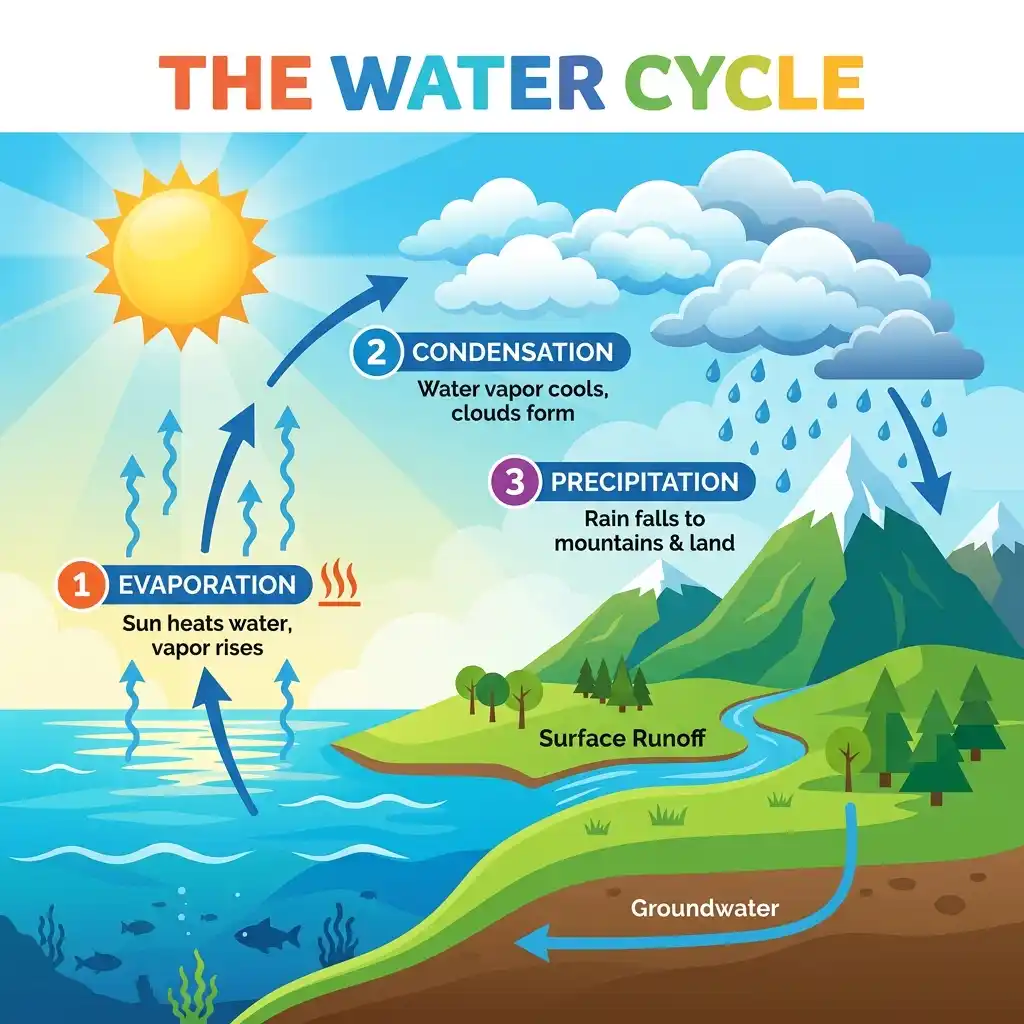
Answer: The continuous movement of water from the Earth’s surface to the atmosphere and back is called the water cycle (or hydrological cycle). It consists of three main processes:
Evaporation: The sun heats the water in oceans, lakes, and rivers. This liquid water turns into water vapor (a gas) and rises into the sky.
Condensation: As the water vapor rises, the air cools down. The vapor cools and condenses back into tiny droplets of water, which group together to form clouds.
Precipitation: When the clouds become saturated and heavy with water, the droplets fall back to the Earth in the form of rain, snow, sleet, or hail.
Collection: The fallen rainwater flows into rivers and oceans, and some seeps into the ground as groundwater. The sun heats it again, and the cycle repeats.
Here is the visual representation of the water cycle:
Q2. [CBSE / State Board] Why should we conserve our natural resources, and how can we do it?
Answer: Natural resources like coal, petroleum, forests, and clean water are gifts from nature. We must conserve them because:
Many resources are non-renewable; once they are exhausted, it takes millions of years for them to form again.
Over-exploitation leads to environmental destruction, global warming, and pollution.
We can conserve them by practising these methods:
Apply the 3 Rs: reduce waste, reuse products, and recycle materials (like paper and plastics).
Save Energy: Turn off electrical appliances when not in use. Walk or use public transport instead of personal cars to save fossil fuels.
Rainwater Harvesting: Collect rainwater to replenish groundwater.
Afforestation: Plant more trees to check soil erosion and maintain ecological balance.
Q3. [ICSE] Explain the difference between weather and climate. Describe at least three factors that influence the climate of a place.
Answer:
Weather: The day-to-day state of the atmosphere at a specific time and place (e.g., a rainy afternoon or a windy morning). It changes very quickly.
Climate: The average weather conditions of a large region over a long period, typically 30 to 40 years (e.g., the tropical climate of India). It remains relatively stable.
Factors Influencing Climate:
Distance from the Equator (Latitude): Places close to the equator are hotter because they receive direct sunlight. Places near the poles are cold because they receive slanting sunlight.
Height above Sea Level (Altitude): The higher you go, the cooler the air becomes. This is why hill stations like Shimla or Ooty are cool even in summer.
Distance from the Sea: Coastal areas have a moderate climate (not too hot, not too cold) due to sea breezes, while areas far inland experience extreme temperatures.
Q4. [CBSE / ICSE] Explain the difference between a map and a globe.
Answer:
A map and a globe are both useful for studying the Earth, but they are different in several ways.
Globe: A globe is a three-dimensional, spherical model of the Earth. It shows the general shape and location of continents and oceans accurately. However, it is bulky and cannot show very small areas in great detail.
Map: A map is a two-dimensional, flat representation of the Earth or a part of it. It is easy to carry and can show detailed information about particular areas such as cities, states, and countries.
Therefore, a globe is useful for understanding the Earth as a whole, while maps are more useful for studying specific areas in detail.
Q5. [CBSE / State Board] Explain latitudes and longitudes and describe their importance.
Answer:
Latitudes and longitudes are imaginary lines used to locate places on the Earth.
Latitudes: Latitudes are imaginary horizontal lines that run parallel to the Equator from east to west. The Equator is at 0° latitude, and latitudes are measured towards the North and South Poles.
Longitudes: Longitudes are imaginary lines that run from the North Pole to the South Pole. The Prime Meridian is at 0° longitude, and longitudes are measured east and west from it.
Importance: Together, latitudes and longitudes help us identify the exact location of places on the Earth. They are also useful for understanding different climate zones and calculating time.
Q6. [CBSE / ICSE / State Board] Explain the three heat zones of the Earth.
Answer:
The Earth is divided into three main heat zones according to the amount and angle of sunlight they receive.
Torrid Zone: It lies between the Tropic of Cancer and the Tropic of Capricorn. It receives direct rays of the Sun and is generally the hottest zone.
Temperate Zone: It lies between the Torrid and Frigid zones. It receives slanting rays of the Sun and has a moderate climate.
Frigid Zone: It is located near the North and South Poles. It receives extremely slanting rays of the Sun and remains very cold.
Thus, the angle of the Sun’s rays plays an important role in determining the temperature of different regions.
Q7. [CBSE / State Board] Explain the three main types of maps and the information they provide.
Answer:
Maps are used to represent different features and information about the Earth.
Physical Maps: These maps show natural features such as mountains, plateaus, plains, rivers, and oceans.
Political Maps: These maps show human-made boundaries and administrative areas such as countries, states, cities, and towns.
Thematic Maps: These maps focus on particular information such as rainfall patterns, road networks, or forest distribution.
Therefore, different maps are used depending on the type of geographical information we want to study.
Q8. [CBSE / ICSE] Explain why the Torrid Zone is the hottest zone on Earth.
Answer:
The Torrid Zone is the hottest heat zone because it lies around the Equator and receives direct rays of the Sun.
The Sun’s rays fall almost vertically in this region and are concentrated over a smaller area. This provides more heat to the Earth’s surface.
In contrast, near the North and South Poles, the Sun’s rays fall at a very slanting angle and spread over a larger area. Therefore, the polar regions receive less heat.
Thus, the direct rays of the Sun make the Torrid Zone the hottest zone on Earth.
Q9. [CBSE / ICSE / State Board] Explain the importance of maps in our daily life.
Answer:
Maps are important tools that help us understand and locate places on Earth.
They help us find countries, states, cities, towns, rivers, mountains, and other geographical features.
Maps are also useful for planning journeys and understanding routes from one place to another.
Different types of maps provide different information. Physical maps show natural features, political maps show boundaries, and thematic maps show specific information such as rainfall or forests.
Therefore, maps are useful for students, travellers, teachers, planners, and many other people.
Q10. [CBSE / State Board] Explain the importance of a globe in studying the Earth.
Answer:
A globe is a three-dimensional spherical model of the Earth. It gives us a better understanding of the Earth’s overall shape.
It helps us identify the positions of continents and oceans and understand their locations in relation to one another.
A globe also helps us understand the Equator, hemispheres, and major lines of latitude and longitude.
Unlike a flat map, a globe represents the Earth in a spherical form.
However, a globe can be bulky and cannot provide detailed information about very small areas.
Q11. [CBSE / ICSE] Explain the role of evaporation and condensation in the water cycle.
Answer:
Evaporation and condensation are two important processes in the water cycle.
Evaporation: The Sun heats water present in oceans, lakes, and rivers. The liquid water changes into water vapour and rises into the atmosphere.
Condensation: As the water vapour rises higher, the surrounding air becomes cooler. The water vapour cools and changes into tiny water droplets.
These droplets come together to form clouds.
Therefore, evaporation moves water from the Earth’s surface into the atmosphere, while condensation helps form clouds.
Q12. [CBSE / State Board] Explain the process of precipitation and collection in the water cycle.
Answer:
Precipitation and collection are important stages of the water cycle.
Precipitation: When clouds become full and heavy with water droplets, the water falls back to Earth as rain, snow, sleet, or hail.
Collection: The water that reaches the Earth’s surface collects in rivers, lakes, and oceans. Some water also seeps into the ground and becomes groundwater.
The collected water can again be heated by the Sun and evaporate, allowing the water cycle to continue.
Thus, precipitation brings water back to Earth, while collection stores it on and below the Earth’s surface.
Q13. [CBSE / ICSE / State Board] Explain the complete water cycle.
Answer:
The water cycle is the continuous movement of water between the Earth’s surface and the atmosphere.
Evaporation: The Sun heats water in oceans, lakes, and rivers, changing it into water vapour.
Condensation: The water vapour rises, cools, and changes into tiny water droplets that form clouds.
Precipitation: When clouds become heavy with water, the water falls to Earth as rain, snow, sleet, or hail.
Collection: Water collects in rivers, lakes, oceans, and underground as groundwater.
The Sun heats the collected water again, and the cycle continues.
Q14. [CBSE / State Board] Why are natural resources important? Explain with examples.
Answer:
Natural resources are materials and substances that come from nature and are useful to humans.
Clean water is needed for drinking, cooking, farming, and many other activities. Forests provide useful products and help maintain ecological balance.
Coal and petroleum are important sources of energy, but many such resources are non-renewable.
Natural resources support human life and economic activities.
Therefore, we must use natural resources carefully and conserve them for future generations.
Q15. [CBSE / ICSE] Explain four ways to conserve natural resources.
Answer:
Natural resources can be conserved through several simple practices.
Reduce, Reuse, and Recycle: We should reduce waste, reuse useful products, and recycle materials such as paper and plastics.
Save Energy: Electrical appliances should be switched off when not in use.
Rainwater Harvesting: Rainwater can be collected and stored to help conserve water and replenish groundwater.
Afforestation: Planting more trees helps protect forests, reduce soil erosion, and maintain ecological balance.
These practices help protect natural resources and the environment.
Q16. [CBSE / State Board] Explain the difference between weather and climate with examples.
Answer:
Weather and climate both describe atmospheric conditions, but they refer to different periods of time.
Weather: Weather is the day-to-day condition of the atmosphere at a particular place and time. For example, a day may be rainy, sunny, cloudy, or windy.
Climate: Climate is the average weather condition of a large region over a long period. For example, a region may have a tropical or cold climate.
Weather can change quickly, while climate remains relatively stable over many years.
Therefore, weather describes short-term conditions, whereas climate describes long-term patterns.
Q17. [CBSE / ICSE] Explain three important factors that influence the climate of a place.
Answer:
The climate of a place is influenced by several factors.
Distance from the Equator: Places near the Equator receive more direct sunlight and are generally hotter. Places near the poles receive more slanting sunlight and are colder.
Altitude: Temperature generally decreases as height above sea level increases. This is why hill stations are often cooler.
Distance from the Sea: Coastal areas usually have a moderate climate because of the influence of sea breezes. Areas far from the sea can experience more extreme temperatures.
These factors help determine the climate of different regions.
Q18. [CBSE / ICSE / State Board] Explain how we can protect the environment while conserving natural resources.
Answer:
We can protect the environment by using natural resources carefully and avoiding unnecessary waste.
We should follow the 3 Rs—Reduce, Reuse, and Recycle—to reduce the amount of waste we produce.
We should save electricity and water and practise rainwater harvesting.
Planting more trees through afforestation helps reduce soil erosion and maintain ecological balance.
We should also avoid polluting rivers, forests, and other natural resources.
By following these practices, we can protect the environment and ensure that natural resources remain available for future generations.
Part C: Class 5 Social Science Previous Year Questions – Civics
Civics in Class 5 generally covers the United Nations, the Indian Constitution, our fundamental rights and duties, and local government bodies. Practising Class 5 Social Science Previous Year Questions in Civics helps students revise the Constitution, Fundamental Rights, Fundamental Duties, the UN, and local government.
Multiple Choice Questions (1 Mark Each)
Q1. [CBSE] When do we celebrate UN Day every year?
a) 15th August
b) 24th October
c) 26th January
d) 2nd October
Answer: b) 24th October
Q2. [CBSE / State Board] Who is known as the Father of the Indian Constitution?
a) Mahatma Gandhi
b) Jawaharlal Nehru
c) Dr B.R. Ambedkar
d) Sardar Vallabhbhai Patel
Answer: c) Dr B.R. Ambedkar
Q3. [CBSE / State Board] At what age does an Indian citizen get the right to vote?
a) 16 years
b) 18 years
c) 21 years
d) 25 years
Answer: b) 18 years
Q4. [ICSE] Which organ of the United Nations is responsible for maintaining international peace and security?
a) General Assembly
b) Security Council
c) Secretariat
d) International Court of Justice
Answer: b) Security Council
Q5. [CBSE / ICSE] What is the tenure of a member of the Rajya Sabha (Upper House of Parliament) in India?
a) 4 years
b) 5 years
c) 6 years
d) 2 years
Answer: c) 6 years
Q6. [CBSE / State Board] What is the main purpose of the United Nations (UN)?
a) To control all countries
b) To maintain international peace and security
c) To make school rules
d) To conduct elections in every country
Answer: b) To maintain international peace and security
Q7. [CBSE / ICSE] Where is the headquarters of the United Nations located?
a) New Delhi
b) London
c) New York City
d) Paris
Answer: c) New York City
Q8. [CBSE / State Board] Which organisation works to develop friendly relations among nations?
a) United Nations
b) Gram Panchayat
c) Supreme Court
d) Parliament
Answer: a) United Nations
Q9. [CBSE / ICSE] Which of the following is one of the objectives of the United Nations?
a) To promote international peace
b) To control schools
c) To make state laws
d) To run village markets
Answer: a) To promote international peace
Q10. [CBSE / State Board] Which UN organ is responsible for maintaining international peace and security?
a) General Assembly
b) Security Council
c) Secretariat
d) International Court of Justice
Answer: b) Security Council
Q11. [CBSE / ICSE] The Constitution of India contains the fundamental rules and principles for:
a) Running a country
b) Running a school
c) Running a shop
d) Running a sports club
Answer: a) Running a country
Q12. [CBSE / State Board] Who is closely associated with the drafting of the Indian Constitution?
a) Dr B.R. Ambedkar
b) Isaac Newton
c) Albert Einstein
d) William Shakespeare
Answer: a) Dr B.R. Ambedkar
Q13. [CBSE / ICSE] What does the Constitution define?
a) The structure and powers of the government
b) The price of vegetables
c) School examination dates
d) Weather conditions
Answer: a) The structure and powers of the government
Q14. [CBSE / State Board] What does the Constitution guarantee to citizens?
a) Rights and duties
b) Free houses for everyone
c) Free vehicles
d) Unlimited resources
Answer: a) Rights and duties
Q15. [CBSE / ICSE] Which of the following is a Fundamental Right?
a) Right to Equality
b) Right to Break Laws
c) Right to Pollute
d) Right to Damage Public Property
Answer: a) Right to Equality
Q16. [CBSE / State Board] What does the Right to Equality mean?
a) Everyone is equal before the law
b) Only rich people are equal
c) Only adults are equal
d) Everyone can make their own laws
Answer: a) Everyone is equal before the law
Q17. [CBSE / ICSE] Which right gives citizens freedom to speak and express their views?
a) Right to Freedom
b) Right to Property
c) Right to Travel Only
d) Right to Government Jobs
Answer: a) Right to Freedom
Q18. [CBSE / State Board] Which Fundamental Right is related to free and compulsory education for children between 6 and 14 years?
a) Right to Equality
b) Right to Education
c) Right to Property
d) Right to Information
Answer: b) Right to Education
Q19. [CBSE / ICSE] Fundamental Rights are given to citizens by the:
a) Indian Constitution
b) United Nations
c) Gram Panchayat
d) School authorities
Answer: a) Indian Constitution
Q20. [CBSE / State Board] At what age can an Indian citizen vote in elections?
a) 16 years
b) 18 years
c) 21 years
d) 25 years
Answer: b) 18 years
Q21. [CBSE / ICSE] Which of the following is a Fundamental Duty?
a) Respecting the National Flag
b) Damaging public property
c) Polluting rivers
d) Breaking laws
Answer: a) Respecting the National Flag
Q22. [CBSE / State Board] Which duty requires citizens to protect the natural environment?
a) Preserving the environment
b) Building roads
c) Buying property
d) Travelling abroad
Answer: a) Preserving the environment
Q23. [CBSE / ICSE] Which of the following is an example of public property?
a) A private bedroom
b) A public park
c) A personal bicycle
d) A schoolbag
Answer: b) A public park
Q24. [CBSE / State Board] What should citizens do with public property?
a) Protect it
b) Damage it
c) Waste it
d) Destroy it
Answer: a) Protect it
Q25. [CBSE / ICSE] Which of the following is a National Symbol that citizens should respect?
a) National Flag
b) School uniform
c) Traffic signal
d) Newspaper
Answer: a) National Flag
Q26. [CBSE / State Board] Fundamental Rights and Fundamental Duties are best described as:
a) Completely unrelated
b) Two sides of the same coin
c) School rules
d) Election rules
Answer: b) Two sides of the same coin
Q27. [CBSE / ICSE] Why should citizens perform their Fundamental Duties?
a) To contribute to the betterment of society and the country
b) To avoid going to school
c) To get free products
d) To make personal laws
Answer: a) To contribute to the betterment of society and the country
Q28. [CBSE / State Board] Which body makes laws for the country?
a) Legislature
b) Judiciary
c) Police
d) Gram Panchayat
Answer: a) Legislature
Q29. [CBSE / ICSE] Which organ of government implements and enforces laws?
a) Executive
b) Legislature
c) Judiciary
d) United Nations
Answer: a) Executive
Q30. [CBSE / State Board] Which organ protects laws and delivers justice?
a) Legislature
b) Executive
c) Judiciary
d) Gram Panchayat
Answer: c) Judiciary
Q31. [CBSE / ICSE] How many main organs of the Government of India are discussed in the lesson?
a) Two
b) Three
c) Four
d) Five
Answer: b) Three
Q32. [CBSE / State Board] Which of the following is one of the three organs of government?
a) Legislature
b) Election Commission
c) School Council
d) Village Club
Answer: a) Legislature
Q33. [CBSE / ICSE] Which body is a part of the Legislature of India?
a) Parliament
b) Supreme Court
c) Police Department
d) Gram Panchayat
Answer: a) Parliament
Q34. [CBSE / State Board] Which two Houses form the Parliament of India?
a) Lok Sabha and Rajya Sabha
b) Supreme Court and High Court
c) Gram Sabha and Gram Panchayat
d) General Assembly and Security Council
Answer: a) Lok Sabha and Rajya Sabha
Q35. [CBSE / ICSE] What is the Rajya Sabha also known as?
a) Lower House
b) Upper House
c) People’s Court
d) Village House
Answer: b) Upper House
Q36. [CBSE / State Board] What is the Lok Sabha also known as?
a) Upper House
b) Lower House
c) State Council
d) Village Council
Answer: b) Lower House
Q37. [CBSE / ICSE] What is the tenure of a member of the Rajya Sabha?
a) 2 years
b) 4 years
c) 5 years
d) 6 years
Answer: d) 6 years
Q38. [CBSE / State Board] Which organ of government interprets laws and delivers justice?
a) Judiciary
b) Legislature
c) Executive
d) Parliament
Answer: a) Judiciary
Q39. [CBSE / ICSE] Which is the highest court in India?
a) District Court
b) High Court
c) Supreme Court
d) Village Court
Answer: c) Supreme Court
Q40. [CBSE / State Board] Which court comes below the Supreme Court in the judicial system described in the lesson?
a) High Court
b) Gram Panchayat
c) Parliament
d) Rajya Sabha
Answer: a) High Court
Q41. [CBSE / ICSE] What is the Panchayati Raj system?
a) A local self-government system for rural areas
b) A system for international organisations
c) A national court system
d) A school management system
Answer: a) A local self-government system for rural areas
Q42. [CBSE / State Board] Which of the following is part of the Panchayati Raj system?
a) Gram Panchayat
b) Supreme Court
c) Rajya Sabha
d) Security Council
Answer: a) Gram Panchayat
Q43. [CBSE / ICSE] How many levels are there in the Panchayati Raj system described in the lesson?
a) Two
b) Three
c) Four
d) Five
Answer: b) Three
Q44. [CBSE / State Board] Which of the following is NOT a tier of the Panchayati Raj system?
a) Gram Panchayat
b) Panchayat Samiti
c) Zilla Parishad
d) Supreme Court
Answer: d) Supreme Court
Q45. [CBSE / ICSE] What is one important purpose of the Panchayati Raj system?
a) To allow local people to participate in decision-making
b) To control other countries
c) To make international laws
d) To conduct school examinations
Answer: a) To allow local people to participate in decision-making
Q46. [CBSE / State Board] Which local issue can be handled by local government bodies in villages?
a) Water supply
b) International peace
c) Foreign policy
d) National defence
Answer: a) Water supply
Q47. [CBSE / ICSE] Which of the following can be a responsibility of local village government?
a) Street lighting
b) International treaties
c) National defence
d) Printing currency
Answer: a) Street lighting
Q48. [CBSE / State Board] Why is local self-government important?
a) It helps people participate in solving local problems
b) It replaces the national government
c) It controls all countries
d) It makes international laws
Answer: a) It helps people participate in solving local problems
Q49. [CBSE / ICSE] Which body represents local self-government at the village level?
a) Gram Panchayat
b) Parliament
c) Supreme Court
d) United Nations
Answer: a) Gram Panchayat
Q50. [CBSE / ICSE / State Board] Which statement correctly describes the three organs of the Government of India?
a) Legislature makes laws, Executive implements laws, and Judiciary interprets laws and delivers justice
b) Legislature delivers justice, Executive makes laws, and Judiciary conducts elections
c) Legislature runs villages, Executive makes maps, and Judiciary maintains forests
d) Legislature maintains international peace, Executive runs the UN, and Judiciary makes school rules
Answer: a) Legislature makes laws, Executive implements laws, and Judiciary interprets laws and delivers justice
Short Answer Type Questions (2-3 Marks Each)
Q1. [CBSE / State Board] What is a constitution?
Answer: A constitution is a comprehensive written document that contains the fundamental rules, laws, and principles by which a country is governed. It defines the structure and powers of the government and guarantees the rights and duties of its citizens.
Q2. [CBSE / ICSE] State any three fundamental rights given to Indian citizens.
Answer: Three fundamental rights guaranteed by the Indian Constitution are:
Right to Equality: Everyone is equal before the law, regardless of religion, race, caste, or gender.
Right to Freedom: Citizens have the freedom to speak, travel, gather peacefully, and reside anywhere in the country.
Right to Education: Free and compulsory education for all children between 6 and 14 years of age.
Q3. [CBSE / ICSE] What is the main objective of the United Nations (UN), and where is its headquarters?
Answer: The main objective of the UN is to maintain international peace and security, prevent wars, develop friendly relations among nations, and solve global social and economic problems. Its headquarters is located in New York City, USA.
Q4. [State Board] What is the Panchayati Raj system? Why is it important?
Answer: The Panchayati Raj system is a three-tier local self-government system for rural areas (Gram Panchayat, Panchayat Samiti, and Zilla Parishad). It is important because it allows local villagers to participate directly in decision-making and solve local issues like water supply, street lighting, and village schooling without relying on the state capital.
Q5. [CBSE / ICSE] Mention any three fundamental duties of Indian citizens.
Answer: Three key fundamental duties are:
Respect National Symbols: To abide by the Constitution and respect the National Flag and the National Anthem.
Protect Public Property: To safeguard public properties (like trains, parks, and monuments) and avoid violence.
Preserve the Environment: To protect and improve the natural environment, including forests, lakes, rivers, and wildlife.
Q6. [CBSE / State Board] Why is the Indian Constitution important?
Answer: The Indian Constitution is important because it provides the basic rules and principles for governing the country. It defines the powers of the government and protects the rights and duties of citizens.
Q7. [CBSE / ICSE] What is the Right to Equality?
Answer: The Right to Equality means that all citizens are equal before the law. No person should be discriminated against on the basis of religion, race, caste, or gender.
Q8. [CBSE / State Board] What is the Right to Freedom?
Answer: The Right to Freedom gives citizens important freedoms such as the freedom to speak, travel, gather peacefully, and reside anywhere in the country, subject to the law.
Q9. [CBSE / ICSE] What is the Right to Education?
Answer: The Right to Education provides free and compulsory education to children between 6 and 14 years of age. It helps ensure that children have access to basic education.
Q10. [CBSE / State Board] Why are Fundamental Rights important?
Answer: Fundamental Rights protect the freedom, equality, and dignity of citizens. They ensure that citizens are treated fairly and can enjoy important freedoms guaranteed by the Constitution.
Q11. [CBSE / ICSE] What are Fundamental Duties?
Answer: Fundamental Duties are responsibilities that citizens should follow for the betterment of the country. They include respecting national symbols, protecting public property, and preserving the environment.
Q12. [CBSE / State Board] Why should citizens respect the National Flag and National Anthem?
Answer: The National Flag and National Anthem are important national symbols. Citizens should respect them as a way of showing respect for the Constitution, the country, and its values.
Q13. [CBSE / ICSE] Why should we protect public property?
Answer: Public property belongs to everyone and is provided for public use. Citizens should protect places and facilities such as parks, trains, roads, and monuments and should never damage them.
Q14. [CBSE / State Board] How can citizens help protect the environment?
Answer: Citizens can protect the environment by keeping surroundings clean, protecting forests, lakes, rivers, and wildlife, and avoiding activities that cause pollution or environmental damage.
Q15. [CBSE / ICSE] What is the United Nations?
Answer: The United Nations is an international organisation that works to maintain peace and security among countries. It also promotes friendly relations and cooperation among nations.
Q16. [CBSE / State Board] When is United Nations Day celebrated?
Answer: United Nations Day is celebrated every year on 24th October. It marks the anniversary of the founding of the United Nations.
Q17. [CBSE / ICSE] Where is the headquarters of the United Nations located?
Answer: The headquarters of the United Nations is located in New York City, USA. The organisation works with countries around the world to promote peace and cooperation.
Q18. [CBSE / State Board] What are the main objectives of the United Nations?
Answer: The main objectives of the United Nations are to maintain international peace and security, prevent wars, develop friendly relations among nations, and help solve global social and economic problems.
Q19. [CBSE / ICSE] How does the United Nations help maintain peace?
Answer: The United Nations works with countries to prevent conflicts and promote peaceful solutions. Its Security Council has an important role in maintaining international peace and security.
Q20. [CBSE / State Board] What is the Security Council of the United Nations?
Answer: The Security Council is an important organ of the United Nations. It has the main responsibility for maintaining international peace and security.
Q21. [CBSE / ICSE] What is the voting age in India?
Answer: An Indian citizen gets the right to vote at the age of 18 years. Citizens can use their vote to participate in elections and choose their representatives.
Q22. [CBSE / State Board] Why is voting important in a democracy?
Answer: Voting allows citizens to participate in the democratic process. Through elections, citizens can choose representatives who make decisions and govern on their behalf.
Q23. [CBSE / ICSE] What is Parliament?
Answer: Parliament is the law-making body of India. It consists of two Houses—the Lok Sabha and the Rajya Sabha.
Q24. [CBSE / State Board] Name the two Houses of the Indian Parliament.
Answer: The two Houses of the Indian Parliament are the Lok Sabha and the Rajya Sabha. The Lok Sabha is also called the Lower House, while the Rajya Sabha is called the Upper House.
Q25. [CBSE / ICSE] What is the Lok Sabha?
Answer: The Lok Sabha is the Lower House of the Parliament of India. Its members are elected by the people through elections.
Q26. [CBSE / State Board] What is the Rajya Sabha?
Answer: The Rajya Sabha is the Upper House of the Parliament of India. A member of the Rajya Sabha has a tenure of six years.
Q27. [CBSE / ICSE] What are the three main organs of government?
Answer: The three main organs of government are the Legislature, Executive, and Judiciary. The Legislature makes laws, the Executive implements them, and the Judiciary interprets laws and delivers justice.
Q28. [CBSE / State Board] What is the role of the Legislature?
Answer: The Legislature is responsible for making laws for the country. In India, Parliament is the main law-making body at the national level.
Q29. [CBSE / ICSE] What is the role of the Executive?
Answer: The Executive is responsible for implementing and enforcing the laws made by the Legislature. It manages the administration of the country.
Q30. [CBSE / State Board] What is the role of the Judiciary?
Answer: The Judiciary interprets laws and delivers justice. It also helps protect the rights of citizens and ensures that laws are followed.
Q31. [CBSE / ICSE] What is the Supreme Court?
Answer: The Supreme Court is the highest court in India. It is an important part of the Judiciary and helps interpret laws and deliver justice.
Q32. [CBSE / State Board] What is the Panchayati Raj system?
Answer: The Panchayati Raj system is a three-tier local self-government system for rural areas. Its three levels are Gram Panchayat, Panchayat Samiti, and Zilla Parishad.
Q33. [CBSE / ICSE] Name the three levels of the Panchayati Raj system.
Answer: The three levels of the Panchayati Raj system are Gram Panchayat at the village level, Panchayat Samiti at the intermediate level, and Zilla Parishad at the district level.
Q34. [CBSE / State Board] What is a Gram Panchayat?
Answer: A Gram Panchayat is a local self-government body at the village level. It helps deal with local issues and provides services needed by people in the village.
Q35. [CBSE / ICSE] What is a Panchayat Samiti?
Answer: A Panchayat Samiti is the intermediate level of the Panchayati Raj system. It works between the Gram Panchayat and the Zilla Parishad.
Q36. [CBSE / State Board] What is a Zilla Parishad?
Answer: A Zilla Parishad is the district-level body of the Panchayati Raj system. It works to coordinate development and local government activities at the district level.
Q37. [CBSE / ICSE] Why is the Panchayati Raj system important?
Answer: The Panchayati Raj system gives rural people an opportunity to participate in local decision-making. It helps communities address local problems and improve village development.
Q38. [CBSE / State Board] Mention three local issues that can be handled by local government bodies.
Answer: Local government bodies can deal with issues such as water supply, street lighting, and village schooling. They help solve problems that directly affect local communities.
Q39. [CBSE / ICSE] How does local self-government help villagers?
Answer: Local self-government allows villagers to participate in decisions affecting their community. It helps them identify local problems and work towards solutions without depending entirely on higher levels of government.
Q40. [CBSE / State Board] What is the difference between Fundamental Rights and Fundamental Duties?
Answer: Fundamental Rights are important rights guaranteed to citizens by the Constitution. Fundamental Duties are responsibilities that citizens should perform to contribute to the country and society.
Q41. [CBSE / ICSE] How are Fundamental Rights and Fundamental Duties related?
Answer: Fundamental Rights give citizens important freedoms and protections, while Fundamental Duties remind citizens of their responsibilities. Both are important for the proper functioning of society and democracy.
Q42. [CBSE / State Board] Why should citizens follow their Fundamental Duties?
Answer: Citizens should follow their Fundamental Duties to contribute to the progress and well-being of the country. Duties such as respecting national symbols, protecting public property, and preserving the environment promote responsible citizenship.
Q43. [CBSE / ICSE] What does responsible citizenship mean?
Answer: Responsible citizenship means knowing and following one’s rights and duties. A responsible citizen respects laws, national symbols, public property, other people, and the environment.
Q44. [CBSE / State Board] How can citizens protect public property?
Answer: Citizens can protect public property by using public facilities carefully and not damaging them. They should protect places such as parks, trains, roads, and monuments because these facilities are meant for everyone.
Q45. [CBSE / ICSE] Why is environmental protection considered an important duty of citizens?
Answer: A clean and healthy environment is important for all living beings. Citizens should protect forests, lakes, rivers, and wildlife and take steps to reduce environmental damage.
Q46. [CBSE / State Board] What is the importance of equality in a democracy?
Answer: Equality ensures that all citizens are treated fairly before the law. It helps prevent discrimination and gives people equal respect and opportunities as citizens.
Q47. [CBSE / ICSE] Why is the Constitution called the basic law of a country?
Answer: The Constitution contains the fundamental rules and principles by which a country is governed. It explains the structure and powers of the government and provides important rights and duties to citizens.
Q48. [CBSE / State Board] How does the Constitution protect citizens?
Answer: The Constitution protects citizens by guaranteeing Fundamental Rights and defining the powers and responsibilities of the government. It provides a framework to ensure fairness, freedom, and equality.
Q49. [CBSE / ICSE] How do the United Nations and national governments differ?
Answer: The United Nations is an international organisation that promotes cooperation, peace, and security among countries. A national government governs and makes laws for its own country and its citizens.
Q50. [CBSE / ICSE / State Board] Why is participation important in a democracy?
Answer: Participation allows citizens to take part in the democratic process. Voting, expressing views, following duties, and participating in local government help citizens contribute to decisions that affect their country and communities.
Long Answer Type Questions (5 Marks Each)
Q1. [CBSE / ICSE / State Board] “Fundamental rights and fundamental duties go hand in hand.” Explain this statement with examples.
Answer: Rights and duties are like two sides of the same coin. The Constitution gives us certain rights to lead a happy and free life, but in return, it expects us to perform certain duties for the betterment of society and the country. We cannot enjoy our rights if we do not fulfil our duties.
Example 1: The Constitution gives us the right to freedom of speech. However, it is our fundamental duty to make sure we do not use our words to abuse, insult, or hurt others or spread lies and hatred.
Example 2: We have the right to travel and enjoy public spaces (parks, museums, and historical monuments). It is our fundamental duty to protect these public properties and keep them clean, rather than vandalising or littering them.
Example 3: We have the right to live in a healthy environment. Consequently, it is our Fundamental Duty not to pollute air and water bodies or cut down forests.
Therefore, being a good citizen means enjoying our rights responsibly while carrying out our duties toward the nation.
Q2. [CBSE / ICSE] Name and explain the three organs of the Government of India and their respective roles.
Answer: The government operates through three distinct organs, ensuring a system of checks and balances:
The Legislature (Parliament): It is the law-making body of the country. It consists of the President, the Lok Sabha (Lower House), and the Rajya Sabha (Upper House).
The Executive: It is responsible for implementing and enforcing the laws made by the Legislature. It consists of the President, Vice-President, Prime Minister, and Council of Ministers.
The Judiciary: It protects the laws, interprets them, and delivers justice to citizens. It solves disputes between citizens, states, and the government. It is headed by the Supreme Court of India, followed by High Courts and District Courts.
Q3. [CBSE / State Board] Explain the importance of the Indian Constitution in the functioning of our country.
Answer: The Indian Constitution is the basic law of our country. It provides the fundamental rules and principles according to which the country is governed. It defines the structure and powers of the government and explains the rights and duties of citizens.
The Constitution guarantees important Fundamental Rights such as the Right to Equality, Right to Freedom, and Right to Education.
It also describes the roles of the Legislature, Executive, and Judiciary. These organs work together to run the country and ensure justice.
Therefore, the Constitution helps maintain democracy, equality, freedom, and responsible government in India.
Q4. [CBSE / ICSE] Explain the main Fundamental Rights given to Indian citizens.
Answer: Fundamental Rights are important rights guaranteed by the Indian Constitution. They protect the freedom, equality, and dignity of citizens.
Right to Equality: It ensures that everyone is equal before the law and prevents discrimination.
Right to Freedom: It gives citizens important freedoms such as freedom of speech, movement, peaceful assembly, and residence.
Right to Education: It provides free and compulsory education to children between 6 and 14 years of age.
These rights help citizens live with freedom, equality, and dignity in a democratic country.
Q5. [CBSE / State Board] Explain the Fundamental Duties of Indian citizens with examples.
Answer: Fundamental Duties are responsibilities that citizens should perform for the betterment of society and the country.
Respect National Symbols: Citizens should respect the National Flag and National Anthem.
Protect Public Property: Citizens should take care of public places and facilities such as parks, trains, roads, and monuments.
Protect the Environment: Citizens should protect forests, lakes, rivers, wildlife, and other parts of the natural environment.
Following these duties helps create responsible citizens and contributes to the development of the country.
Q6. [CBSE / ICSE / State Board] Explain the role and importance of the United Nations.
Answer: The United Nations is an international organisation that works with countries around the world.
Its main objective is to maintain international peace and security and help prevent wars and conflicts.
The United Nations also works to develop friendly relations among nations and promote cooperation.
It helps countries work together to solve global social and economic problems.
The headquarters of the United Nations is located in New York City, USA, and United Nations Day is celebrated on 24th October every year.
Q7. [CBSE / State Board] Explain the main objectives of the United Nations.
Answer: The United Nations has several important objectives.
Maintaining Peace: It works to maintain international peace and security and prevent conflicts between countries.
Developing Friendly Relations: It encourages countries to cooperate and develop peaceful relationships.
Solving Global Problems: It helps countries work together to address social and economic problems.
Promoting Cooperation: It provides a platform where countries can discuss common problems and find peaceful solutions.
Thus, the United Nations plays an important role in promoting peace and cooperation among nations.
Q8. [CBSE / ICSE] Explain the three organs of government and why they are important.
Answer: The government has three main organs: the Legislature, Executive, and Judiciary.
Legislature: It makes laws for the country. In India, Parliament is the main law-making body.
Executive: It implements and enforces the laws made by the Legislature.
Judiciary: It interprets laws, settles disputes, and delivers justice. The Supreme Court is the highest court in India.
These three organs have different responsibilities and work together to ensure that the government functions properly.
Q9. [CBSE / State Board] What is Parliament? Explain its two Houses.
Answer: Parliament is the main law-making body of India. It consists of two Houses: the Lok Sabha and the Rajya Sabha.
Lok Sabha: It is known as the Lower House. Its members are elected by the people through elections.
Rajya Sabha: It is known as the Upper House. A member of the Rajya Sabha has a tenure of six years.
Both Houses participate in the law-making process and discuss important matters related to the country.
Q10. [CBSE / ICSE] Explain the role of the Judiciary in India.
Answer: The Judiciary is one of the three main organs of the government. It interprets laws and delivers justice.
It settles disputes between citizens and can also deal with disputes involving states and the government.
The Supreme Court is the highest court in India, followed by High Courts and District Courts.
The Judiciary also helps protect the rights of citizens and ensures that laws are properly interpreted and followed.
Q11. [CBSE / State Board] Explain the Panchayati Raj system and its three levels.
Answer: The Panchayati Raj system is a three-tier local self-government system for rural areas.
Gram Panchayat: It works at the village level and deals with local issues and development.
Panchayat Samiti: It works at the intermediate level and coordinates activities among villages.
Zilla Parishad: It works at the district level and coordinates development activities across the district.
The system allows local people to participate in decision-making and solve problems affecting their communities.
Q12. [CBSE / ICSE] Why is local self-government important? Explain with examples.
Answer: Local self-government is important because local people understand the problems and needs of their own communities.
It allows villagers to participate in decision-making and work together to solve local problems.
Local government bodies can deal with issues such as water supply, street lighting, village schooling, sanitation, and other local needs.
This system reduces dependence on higher levels of government for every local issue.
Therefore, local self-government strengthens people’s participation in democracy.
Q13. [CBSE / State Board] Explain how citizens can be responsible members of society.
Answer: Responsible citizens understand both their rights and duties.
They should respect the Constitution, National Flag, and National Anthem.
They should protect public property and avoid damaging public facilities.
Citizens should also protect the environment by keeping their surroundings clean and caring for forests, rivers, lakes, and wildlife.
By following laws, respecting others, performing their duties, and participating responsibly in society, citizens contribute to the progress of the country.
Q14. [CBSE / ICSE] Explain the relationship between democracy, voting, and responsible citizenship.
Answer: Democracy gives citizens the opportunity to participate in the government of their country.
Voting is an important way for citizens to participate in elections and choose their representatives. In India, citizens can vote after reaching the age of 18 years.
However, responsible citizenship involves more than voting. Citizens should also respect laws, perform their Fundamental Duties, protect public property, and care for the environment.
Thus, voting and responsible behaviour together help strengthen democracy.
Q15. [CBSE / State Board] Explain why equality is important in a democratic country.
Answer: Equality is an important principle of democracy. The Right to Equality ensures that citizens are treated equally before the law.
It helps prevent unfair discrimination based on factors such as religion, race, caste, or gender.
Equality gives citizens a sense of dignity and fairness.
It also helps ensure that every citizen can participate in society without being treated unfairly.
Therefore, equality is necessary for a fair and democratic society.
Q16. [CBSE / ICSE] Explain the importance of the Right to Education.
Answer: The Right to Education is an important right provided by the Indian Constitution.
It provides free and compulsory education for children between 6 and 14 years of age.
Education helps children gain knowledge and develop skills needed for their future.
It also gives children better opportunities to participate in society and contribute to the country.
Therefore, the Right to Education helps promote equality and provides children with an opportunity to learn and develop.
Q17. [CBSE / State Board] Explain how citizens can protect public property and the environment.
Answer: Public property and the environment are important for the well-being of everyone.
Citizens should use public facilities such as parks, roads, trains, and monuments carefully and should never damage or vandalise them.
They should also avoid littering and pollution and protect forests, rivers, lakes, and wildlife.
Planting trees, saving water, reducing waste, and keeping surroundings clean are some ways to protect the environment.
By protecting public property and nature, citizens fulfil important responsibilities towards society.
Q18. [CBSE / ICSE] Explain how the different levels of government help people in India.
Answer: Different levels of government have different responsibilities and work together to serve people.
The national government deals with matters concerning the country as a whole, while state governments handle matters related to their respective states.
Local government bodies deal with issues that directly affect communities and villages.
In rural areas, the Panchayati Raj system helps people participate in local decision-making through the Gram Panchayat, Panchayat Samiti, and Zilla Parishad.
Together, these levels of government help manage public services and address the needs of people.
Q19. [CBSE / ICSE / State Board] Explain how citizens’ rights and duties help build a better country.
Answer: Rights and duties are both important for the proper functioning of society.
Fundamental Rights give citizens freedom, equality, and protection. They allow people to live with dignity and participate in society.
At the same time, citizens have duties such as respecting national symbols, protecting public property, and preserving the environment.
When citizens enjoy their rights responsibly and perform their duties sincerely, they contribute to peace, development, and social harmony.
Therefore, a strong democracy depends on citizens understanding both their rights and responsibilities.
Q20. [CBSE / State Board] Explain how local government helps solve problems in rural areas.
Answer: Local government helps rural communities deal with problems that directly affect their daily lives.
The Gram Panchayat works at the village level and can address issues such as water supply, street lighting, sanitation, and village schooling.
The Panchayat Samiti works at the intermediate level, while the Zilla Parishad works at the district level.
These bodies allow local people to participate in decision-making and discuss the needs of their communities.
Thus, local government makes administration more responsive to the needs of rural people.
Teacher Shilki’s Top Tips for Writing Perfect Social Science Answers
As a teacher who has corrected thousands of exam papers, I want to share some secret tips with my students. If you follow these, your marks will definitely improve!
- Read the Question Twice: Sometimes a question asks for “two reasons”, but students write a long paragraph with only one reason. Read carefully to know exactly what the examiner wants.
- Use Bullet Points: Teachers love bullet points! Instead of writing a massive paragraph that is hard to read, break your answer into clear bullet points. Number them 1, 2, 3…
- Underline Keywords: If you are explaining the water cycle, underline words like ‘Evaporation’, ‘condensation’, and ‘precipitation’ with a pencil. It shows the teacher that you know your vocabulary.
- Draw Diagrams Even if Not Asked: If a 5-mark question is about the Solar System, draw a quick, neat diagram of the sun and planets next to your answer. It makes a great impression.
- Answer According to Marks: A 1-mark question needs a 1-line answer. A 5-mark question needs a detailed answer with at least 4-5 distinct points. Do not waste 15 minutes writing a page for a 2-mark question!
- Keep Handwriting Neat: I know you might be rushing against the clock, but try to keep your handwriting legible. Leave a line after every completed answer so the paper looks tidy.
How Parents Can Use This Questionnaire at Home
Parents, this resource is a goldmine if used correctly. Please do not just hand this printout to your child and ask them to memorise it. Instead, use it interactively:
- Weekly Quizzes: Use the MCQs for a fun pop-quiz during dinnertime.
- Open Book Tests: For the first few times, let your child find the answers to these questions in their textbook. Finding the answer is a great way of learning it.
- Mock Exams: Two weeks before the final exam, create an environment like a real exam hall. Set a timer, take away the books, and ask them to solve the long-answer questions.
- Positive Reinforcement: If they get an answer wrong, don’t scold them. Say, “Ah, tricky one! Let’s read the textbook together and find out why.”
More Free Resources on This Website
If you found this Class 5 Social Science Previous Year Questions guide helpful, you will love the other resources available on this platform. I am constantly uploading new materials for primary classes.
You can also find:
- Class 5: Our Solar System and Environment Chapter Explanation
- Top Revision Tips for Social Science Exam Class 3 to 5
- Free Class 5 Social Science Revision Worksheets PDF
- How to Make a Social Science Project File for Class 5
- Class 5 Science and Math Revision Worksheets
I strongly believe that quality education materials should be accessible to everyone, which is why all these resources are 100% free to download and use.
If you’re looking for effective and engaging social science lesson plans, check out our Best Lesson Plans for Social Science guide. It provides practical teaching ideas, activities, and structured lesson plans to make social science easier and more interesting for students.
Conclusion
Regular practice of Class 5 Social Science Previous Year Questions with Answers 2026 can help students identify important topics, improve revision, and prepare better for their Social Science examination. Exams can be a stressful time for both children and parents, but they don’t have to be. With the right tools and a little bit of planning, revising for social science can actually become an enjoyable journey of recalling amazing facts about our world.
These Class 5 Social Science Previous Year Questions with Answers have been carefully selected to cover the most vital areas of the syllabus. By practising these, your child will walk into their exam hall feeling prepared, calm, and confident.
Always remind your children that exams are just a way to show what they know; they are not a measure of how smart or wonderful they are as human beings. Their worth is so much more than the marks on a report card. Praise their effort, their hard work, and their dedication, regardless of the final grade.
If you have any specific requests for question papers, or if there is a particular chapter your child is struggling with, please leave a comment or send me an email. I will create a custom worksheet for you.
Thank you so much for visiting KidsTeacherShilki.in. Please share this page with other parents in your school’s WhatsApp groups so that more children can benefit from these free resources.
Let’s raise happy, loving, and confident children together! Good luck with the exams!
With warmth and best wishes,
Shilki Kumari
Kids Teacher Shilki