Summary
This article provides chapter-wise Class 5 Science Important Questions and Answers covering topics such as the human body, plants, forests, animals, food, water, air, fuels, and the solar system. It helps students understand important concepts, revise effectively, and prepare for school examinations with simple explanations and useful study tips.
Hello Class 5 Students and Parents!
Welcome to KidsTeacherShilki.in ❤️
Class 5 Science Important Questions and Answers are among the best ways for students to revise key concepts before examinations. As a teacher, I have noticed that many children find science difficult because they try to memorise everything rather than understand the concepts. With proper practice and regular revision, science becomes easy, interesting, and enjoyable. In this guide, I have compiled chapter-wise Class 5 Science Important Questions and Answers in simple language to help students learn faster, remember concepts longer, and score better marks in exams.
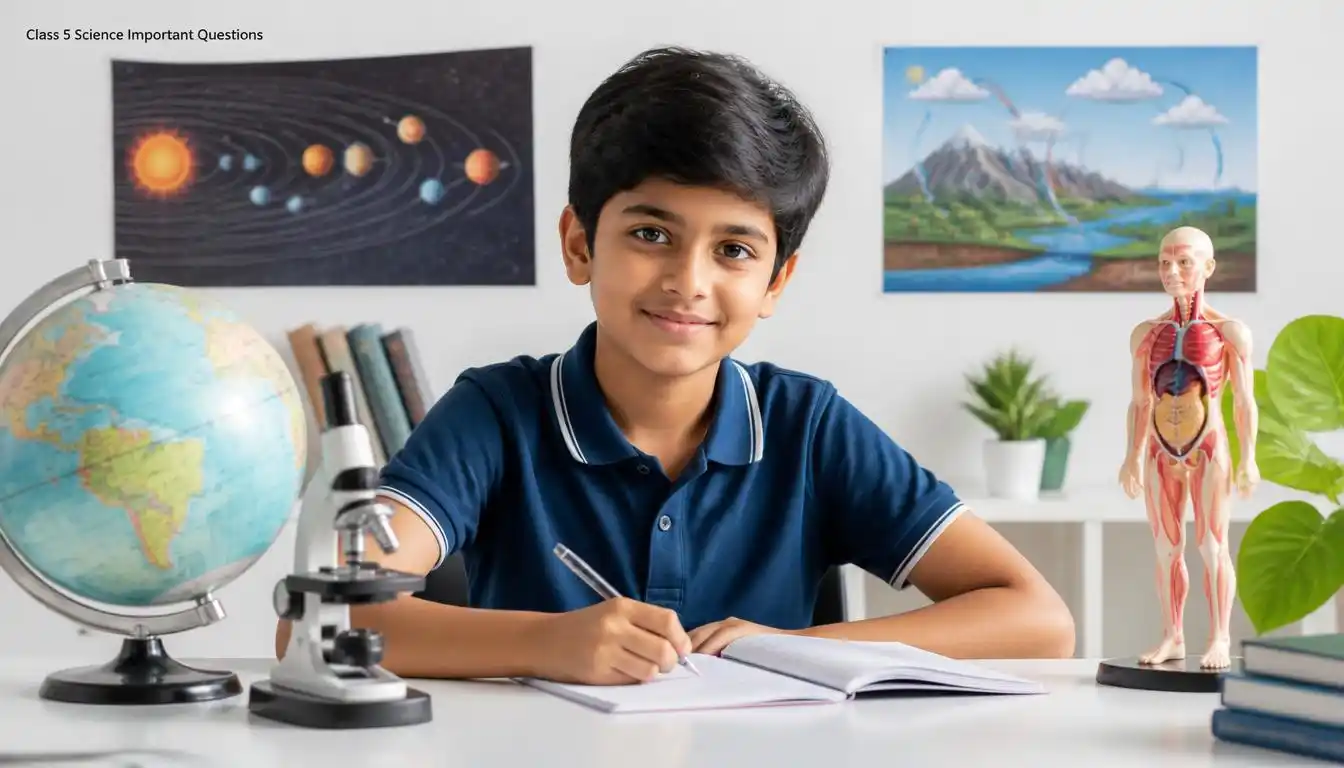
Class 5 Science Important Questions and Answers – Chapter-Wise Study Guide
Science is a very interesting and fun subject. It teaches us about our body, plants, animals, food, water, air, fuels, and our beautiful solar system.
Many students find science difficult only because they try to memorise everything. But if you understand the concepts clearly, science becomes easy and enjoyable.
In this very detailed guide, I have collected the most important questions and answers from all major chapters of Class 5 Science. All answers are written in super-simple language with extra interesting facts so that you can understand and remember them easily.
Let’s study chapter by chapter!
Chapter 1: My Body
Q1. What are the main parts of our body?
Answer: The main parts of our body are the head, neck, trunk, and limbs (hands and legs).
Q2. What is the function of our skeleton?
Answer: The skeleton gives shape and support to our body. It protects important organs like the brain, heart, and lungs.
Q3. Name the five sense organs.
Answer: Eyes (see), ears (hear), nose (smell), tongue (taste), skin (touch).
Q4. Why should we keep our bodies clean?
Answer: Keeping our bodies clean prevents diseases and makes us feel fresh and healthy.
Q5. What is the role of muscles?
Answer: Muscles help us to move, walk, run, lift things, and smile.
Extra Fact: Our body has 206 bones. The smallest bone is in our ear.
Chapter 2: Plants
Q1. What are the main parts of a plant?
Answer: Root, stem, leaves, flowers, and fruits.
Q2. What is the function of roots?
Answer: Roots fix the plant in the soil and absorb water and minerals from the soil.
Q3. Why are leaves called the kitchen of the plant?
Answer: Leaves prepare food for the plant through the process of photosynthesis.
Q4. What is photosynthesis?
Answer: Photosynthesis is the process by which green plants make their own food using sunlight, water, and carbon dioxide.
Q5. What do we get from plants?
Answer: We get food, oxygen, medicines, clothes (cotton), wood, and paper from plants.
Extra Fact: Plants release oxygen during the day, which we breathe.
Chapter 3: Forests
Q1. What is a forest?
Answer: A large area of land covered with many trees and plants is called a forest.
Q2. Why are forests important to us?
Answer: Forests give us wood, medicines, fresh air, rainfall, and prevent soil erosion. They are also home to many animals.
Q3. What is deforestation?
Answer: Cutting down trees on a large scale is called deforestation.
Q4. How can we protect forests?
Answer: By planting more trees, not cutting trees unnecessarily, and spreading awareness.
Q5. Name some animals found in forests.
Answer: Lion, tiger, elephant, deer, monkey, and many birds.
Extra Fact: Forests are called the “lungs of the Earth” because they provide fresh oxygen.
Chapter 4: Animals – Our Friends
Q1. How are animals useful to us?
Answer: Animals give us milk, eggs, wool, meat, leather, and help in farming and transportation.
Q2. What are wild animals? Give examples.
Answer: Wild animals live in jungles. Examples: lion, tiger, elephant, giraffe.
Q3. What are domestic animals?
Answer: Domestic animals are tamed by humans. Examples: cow, dog, cat, horse, goat.
Q4. Why should we be kind to animals?
Answer: Animals are our friends. They help us in many ways, so we should love and protect them.
Q5. What is the difference between herbivorous, carnivorous, and omnivorous animals? Answer:
- Herbivorous → Eat only plants (Cow, Goat)
- Carnivorous → Eat only meat (Lion, Tiger)
- Omnivorous → Eat both plants and meat (Human, Bear)
Chapter 5: Food and Health
Q1. Why do we need food?
Answer: We need food for energy, growth, and to stay healthy.
Q2. What are the different components of food?
Answer: Carbohydrates, Proteins, Fats, Vitamins, Minerals, and Water.
Q3. What is a balanced diet?
Answer: A balanced diet contains all the nutrients in proper amounts.
Q4. Name some energy-giving foods.
Answer: Rice, chapati, bread, sugar, potatoes.
Q5. Why should we eat fruits and vegetables?
Answer: They give us vitamins and minerals, which protect us from diseases.
Chapter 6: Spoilage and Wastage of Food and Food Preservation
Q1. What is food spoilage?
Answer: When food becomes unfit to eat due to bacteria, fungi, or moisture, it is called food spoilage.
Q2. How can we prevent food wastage?
Answer: Take only what you can eat, store food properly, and use leftovers wisely.
Q3. Name some methods of food preservation.
Answer: Drying, pickling, refrigeration, canning, and adding preservatives.
Q4. Why do we keep food in the refrigerator?
Answer: Low temperature slows down the growth of bacteria and keeps food fresh for longer.
Chapter 7: Importance of Water
Q1. Why is water important to us?
Answer: Water is essential for drinking, cooking, bathing, farming, and the survival of all living beings.
Q2. What are the sources of water?
Answer: Rivers, lakes, ponds, wells, rainwater, and groundwater.
Q3. What is the water cycle?
Answer: The continuous movement of water from the earth to the sky and back to the earth is called the water cycle.
Q4. How can we save water?
Answer: Turn off taps, fix leaks, use buckets instead of showers, and reuse water.
Chapter 8: Properties of Water
Q1. What are the properties of water?
Answer: Water is colourless, tasteless, and odourless, and can exist in three forms — solid (ice), liquid, and gas (vapour).
Q2. What is the boiling point of water?
Answer: 100°C.
Q3. What is the freezing point of water?
Answer: 0°C.
Q4. Why does ice float on water?
Answer: Ice is lighter than water, so it floats.
Chapter 9: Fuels
Q1. What are fuels?
Answer: Fuels are substances that give us heat and energy when burnt.
Q2. Name some common fuels.
Answer: Wood, coal, petrol, diesel, LPG, CNG, and natural gas.
Q3. What are fossil fuels?
Answer: Coal, petroleum, and natural gas are fossil fuels.
Q4. Why should we use fuels carefully?
Answer: Fossil fuels are limited and cause pollution when burnt.
Chapter 10: Air
Q1. Why is air important?
Answer: We need air to breathe. It also helps in burning, pollination, and weather.
Q2. What is the composition of air?
Answer: Air contains nitrogen (78%), oxygen (21%), carbon dioxide, and other gases.
Q3. What is air pollution?
Answer: When harmful gases and smoke mix with air, it is called air pollution.
Q4. How can we keep the air clean?
Answer: Plant more trees, avoid burning plastic, and use public transport.
Chapter 11: Our Solar System
Q1. What is the Solar System?
Answer: The Sun and all the planets, moons, asteroids, and comets that revolve around it form the Solar System.
Q2. How many planets are there in our Solar System?
Answer: There are 8 planets.
Q3. Name the planets in order.
Answer: Mercury, Venus, Earth, Mars, Jupiter, Saturn, Uranus, Neptune.
Q4. Which planet is called the Red Planet?
Answer: Mars.
Q5. Which is the largest planet?
Answer: Jupiter.
Chapter 12: Observing the Sky
Q1. What can we see in the sky during the day?
Answer: Sun, clouds, and sometimes birds and aeroplanes.
Q2. What can we see in the night sky?
Answer: Moon, stars, planets, and sometimes shooting stars.
Q3. What is a constellation?
Answer: A group of stars that form a pattern or shape is called a constellation. Example: Saptarishi (Great Bear).
Q4. Why does the Moon look different every night?
Answer: Because we see different illuminated parts of the Moon from Earth. These are called phases of the Moon.
Discover the Top 10 Teaching Aids and Tools for Primary Social Science – Best Classroom Learning Resources 2026 that make learning more engaging, interactive, and effective for young students. From maps and globes to digital learning apps and educational charts, these resources help children understand social science concepts easily. Along with this, students can also access Class 5 Science Important Questions and Answers with Solutions 2026 to strengthen their exam preparation, improve problem-solving skills, and achieve better academic results.
Download the PDF file below here

Class 5 Science Important Questions and Answers with Expert Tips to Score High Marks in Exams
Conclusion
Science is all around us. If you study these Class 5 Science Important Questions and Answers regularly with full understanding, you will not only score excellent marks but also develop a love for learning.
Start today. Be regular. Draw diagrams daily. You can achieve great success!
All the very best for your exams! Study hard and make your parents and teachers proud.